Why Not Us? Better Yet: Why Not the Rest of Us?


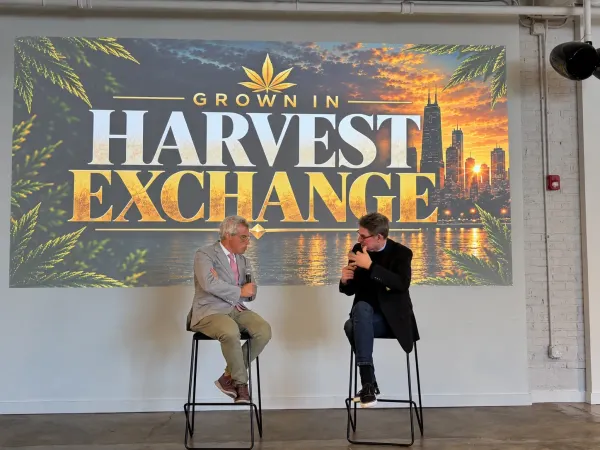
On Oct. 8, Grown In is bringing Illinois cannabis stakeholders, rivals, regulators, investors, advocates, public officials and assorted freaks into the same Chicago rooms. The objective is not consensus. It is progress.
When Dusty Baker arrived in Chicago to manage the Cubs in late 2002, he looked at nearly a century of accumulated civic trauma and asked a wonderfully simple question:
Why not us?
It almost worked immediately.
The 2003 Cubs had Kerry Wood. Mark Prior. Sammy Sosa. Moises Alou. Kenny Lofton. They got very good, very fast.
Maybe too much, too fast.
There were arms carrying loads that would eventually prove unsustainable. There was an eighth inning nobody in Chicago needs reconstructed. There was also a cameo by a fan who absorbed vastly more blame than he deserved and who, at minimum, should never again have to buy his own beer in Bridgeport or suburban St. Louis.
Dusty didn't finish the job.
So what?
The White Sox finished theirs in 2005 — a World Series championship that our good friends in Bristol have occasionally treated with the historical prominence of a Tuesday rain delay.
Theo Epstein and company eventually finished the Cubs' job in 2016.
And Dusty Baker finally got his ring in Houston in 2022, after being hired to steady a franchise coming out of its infamous sign-stealing scandal. Dusty himself didn't hack the system. He was the guy brought in after somebody else had.
There may be a cannabis lesson in all of this.
Stop Waiting for the Schedule
Illinois cannabis has spent years waiting for the next thing.
Schedule I.
Schedule III.
A federal rule.
The next Farm Bill.
The next legislative session.
The next lawsuit.
The next mayor.
The next governor.
The next license.
The next round of capital.
The next promised fix to the last promised fix.
Some of those things matter enormously.
But industries are not built by waiting for the schedule to become perfect.
They are built when sufficiently invested stakeholders decide to make the current circumstances workable.
Major League Baseball is hardly anybody's model of institutional harmony. Owners fight players. Big-market teams fight small-market teams. Managers fight umpires. Agents fight everybody. Sportswriters complain for a living.
And somehow they still play 162 games.
That may be the useful part.
Progress doesn't require everybody to suddenly like each other.
It requires everybody to remain on the field.
An Airing of Grievances — for the Rest of Us
Which brings us, naturally, to Festivus.
Illinois cannabis could use an Airing of Grievances.
Not another press conference where everybody already agrees.
Not another industry panel consisting entirely of people whose economic interests align.
Not another conversation in which "stakeholder engagement" means explaining a decision after it has largely been made.
A real airing.
Licensed cannabis operators.
Craft growers.
Infusers.
Social-equity entrepreneurs who are tired of being treated like a talking point.
Hemp-beverage companies.
Liquor retailers.
Consumer brands.
Investors.
Family offices.
Regulators.
Lawmakers.
Lawyers.
Higher education.
Researchers.
Public-health people.
Journalists.
Consumers.
People who think Illinois cannabis policy is fundamentally working.
People who think it is fundamentally broken.
And people who simply want to know why buying a plant-derived product has to involve this much government, litigation, capital, tribalism and pot pork.
The emphasis is on the rest of us.
No aluminum pole required.
Unless your name happens to be Dick Pole, in which case Grown In will respectfully await your new cannabis-industry title.
The Wind. The Pitch.
On Oct. 8, on an early-autumn day in Chicago's Avondale neighborhood, Grown In will convene a marijuana Murderers' Row — except this lineup isn't being assembled to hit home runs off one another.
We are putting people in sequence.
Private conversations.
Public conversations.
Operators.
Elected officials.
Current and would-be occupants of Chicago's fifth floor.
Illinois lawmakers.
Regulators from agencies that know considerably more about this marketplace than they are always able to say in the same room.
Publicly traded cannabis companies.
Independent operators.
Venture investors.
Family offices.
Social-equity realists.
Academics.
Scribes.
Freaks.
And others who actually care about what happens next.
The proposition is very Chicago:
Maybe our comparative advantage isn't inventing the next thing. Maybe it is figuring out how the next thing actually works.
We didn't invent artificial intelligence.
We didn't invent TikTok.
We certainly didn't invent consulting.
But Chicago has produced generations of people very good at taking complicated systems and turning them into business applications.
We reversed a river.
We figured out how to build very tall buildings on ground that did not initially seem particularly enthusiastic about holding them.
And long before "design thinking" acquired expensive conference badges, Chicago developed another useful operating system:
Yes, and.
Accept the reality in front of you.
Then build from it.
November 12 Is Coming
That mindset matters because Illinois cannabis does not have unlimited time for another round of separate tribal meetings.
On Nov. 12, the economics of intoxicating hemp in Illinois change dramatically.
Illinois' new framework moves intoxicating hemp products into the regulated cannabis system. Outside that system, the legal space for THC products becomes exceedingly narrow.
Whatever one thinks of that policy — overdue consumer protection, incumbent protectionism, equity preservation, economic disruption, or some combination of all four — the marketplace that exists today is going to change.
That should concentrate everybody's attention.
Because there are legitimate grievances on every side.
Licensed cannabis operators can reasonably ask why they spent enormous sums navigating one of America's most restrictive regulatory systems while competitors sold psychoactive THC products through channels with radically different costs and rules.
Social-equity operators can reasonably ask why nearly every new market innovation seems to create somebody else's workaround before they have recovered from the last barrier.
Hemp companies can reasonably ask why a legal consumer category with obvious demand should be commercially squeezed instead of intelligently regulated.
Retailers can ask for rules they can actually understand and follow.
And consumers can ask the most irritatingly sensible question of all:
Why can't products that get people high simply have understandable potency, testing, labeling, age restrictions and rules — regardless of which regulatory family tree produced them?
Here's the use case I want my hemp-beverage friends to confront directly.
Suppose a neighborhood liquor store can sell an inexperienced consumer a 50-milligram THC can without the consumer appreciating what 50 milligrams may mean.
That isn't a victory for hemp.
It is an invitation for the next Maureen Dowd story, except this time amplified instantly across TikTok, Instagram, neighborhood Facebook groups and the inboxes of every elected official in Illinois.
A responsible 2- or 5-milligram beverage designed for a social occasion is a very different consumer proposition from a 50-milligram product.
If hemp wants that distinction understood, hemp needs to show up and make the case in one voice where possible — and openly explain its disagreements where it isn't.
Show your cards.
The pioneering Illinois cannabis operators are doing exactly that, imperfectly and with substantial disagreement among themselves.
That is still progress.
You cannot influence rivals from a room you refuse to enter.
Why Not Chicago?
That brings us back to Dusty.
"Why not us?" is a great rallying cry.
But it becomes dangerous when every faction defines us as only itself.
Why not dispensaries?
Why not hemp?
Why not social equity?
Why not MSOs?
Why not craft?
Why not consumers?
Why not regulators?
Why not Chicago?
The more useful question now is:
Why not the rest of us?
Why can't Chicago assemble enough of the people who disagree about cannabis to identify the places where their interests actually overlap?
Consumer safety.
Predictable regulation.
Responsible access.
Viable businesses.
Real equity rather than ceremonial equity.
Reasonable taxation.
Products whose potency people understand.
Rules that distinguish between a low-dose beverage and a product designed to launch an experienced consumer into another time zone.
And an Illinois cannabis economy capable of exporting expertise rather than merely exporting grievances.
We do not need everybody to agree on Oct. 8.
God forbid.
We need everybody to participate.
Bring a grievance.
Bring data.
Bring a rival.
Bring one thing you absolutely cannot accept.
And, more importantly, bring one thing you could accept if somebody on the other side moved too.
That is how industries mature.
That is how Chicago works when Chicago works.
And that is how you stop waiting for somebody in Springfield or Washington to tell you that the schedule has finally cleared.
Oct. 8. Avondale.
The wind.
The pitch.
Why not us?
Better yet:
Why not the rest of us?
Participate
If you operate, regulate, invest in, sell, study, report on, advocate around or simply care about the future of cannabis in Illinois, Grown In wants you in the conversation.
Come participate in the Oct. 8 Grown In Harvest Exchange.
Don't come because everybody in the room agrees with you.
Come because they don't.