The Killer App Was a Can. Now What?


There is a certain kind of cannabis person who will understand this immediately.
You remember the first time the industry felt inevitable.
Maybe it was 2015, when medical cannabis still carried the energy of a startup crossed with a social movement. Maybe it was 2019, when Illinois legalized adult use and everyone had a deck, a thesis and somebody who “knew somebody in Springfield.” Maybe you arrived in 2025, when beverages, hospitality, technology and research made cannabis feel less like a sector and more like an operating system quietly installing itself across American life.
Whatever year you jumped in, you probably remember the charge.
Not the stock chart. Not the licensing spreadsheet. The charge.
The feeling that this strange plant, criminalized for generations and suddenly surrounded by bankers, scientists, attorneys, activists, chefs, technologists, regulators and people who had been arrested for possessing it, might force us to invent something new.
Then, naturally, Chicago happened.
Hope became regulation. Regulation became litigation. Capital became scarce. Social equity became both mission and battleground. Operators who had raised millions discovered that millions were not nearly enough. People who had waited years for licenses finally got them just in time for interest rates to rise, investors to disappear and consumers to become extremely good at finding discounts.
Cannabis, it turns out, is an excellent teacher of humility.
Being in this industry sometimes feels like being a Bears fan in September.
For one beautiful moment, everything is possible. The new system looks great. The offense is moving. Somebody on television says “this could be the year.” You begin doing dangerous things like imagining January.
Then the starter goes down.
Then the backup goes down.
Then a third-string journeyman is taking snaps against an elite defense while you stare at the screen thinking: technically, there is still a path.
Somehow, you keep watching.
That may be the thing about cannabis people.
We keep watching.
More accurately, we keep working.
For seven years, Grown In has watched Illinois cannabis become an industry in real time. We covered the transition from medical to adult use. We worked with 1871 on the Cannabis Innovation Lab. We experimented with marketplaces and consumption. On 4/20/23, we parked the Sesh Bus near the Merchandise Mart during morning rush hour for our Wake & Make, because nothing says normalization like asking Chicagoans at 7:30 a.m. what a business breakfast might someday mean.
We helped support the Cannabis Research Institute, putting money behind Illinois scientists studying the medical, agricultural and social applications of the plant.
Then I wandered off.
A civic sabbatical at the University of Illinois took me into quantum computing, responsible artificial intelligence and a question that now seems increasingly relevant to cannabis: how do emerging industries build the civic infrastructure necessary to survive themselves?
When I returned, cannabis had produced its killer application.
A can.
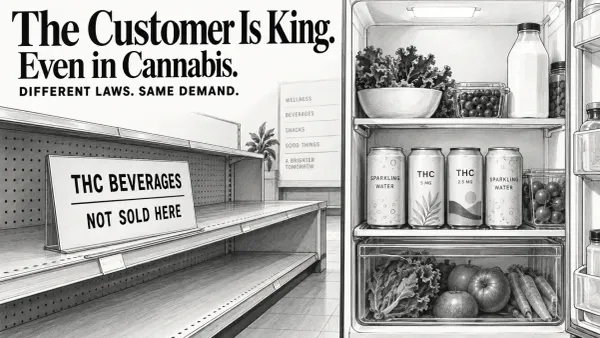
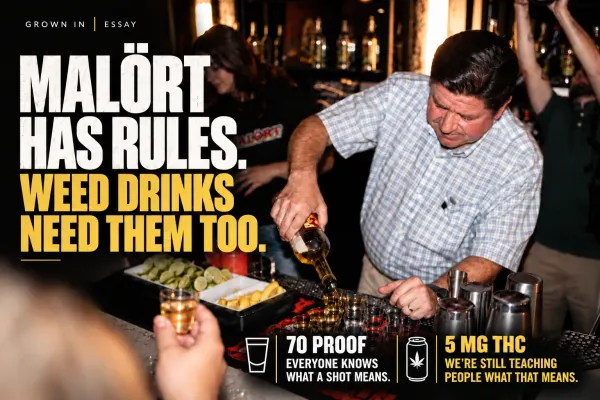
The 2018 Farm Bill loophole created plenty of nonsense. It also accidentally funded one of the largest cannabis consumer experiments ever conducted. People discovered they like drinking modest amounts of THC.
Not necessarily in a dispensary.
At dinner.
At a brewery.
At a concert.
At a neighborhood store.
At a party where one person wants a beer, another wants a gummy and someone else wants a three-milligram beverage without explaining their worldview.
That is not a lobbying position.
It is consumer behavior.
And now, because this is cannabis, the breakthrough has arrived at approximately the same moment as the regulatory reckoning.
Illinois is preparing to dramatically change the rules around intoxicating hemp. Licensed cannabis operators reasonably ask why competitors should sell intoxicating products without bearing the costs, taxes and restrictions they have carried for years. Beverage entrepreneurs reasonably point out that they have built products consumers enjoy in places consumers already go.
Both groups can produce spreadsheets proving they are right.
Fantastic.
Let’s get them in the same room.
On October 8, Grown In returns to Sarabande in Avondale for the Fall Harvest Exchange.
We are bringing together licensed cannabis operators, beverage companies, hospitality leaders, lawmakers, researchers, investors, technologists, regulators, journalists and people who still answer our calls.
State Rep. Will Guzzardi, who helped carry Illinois’ new hemp framework, is scheduled to join us. So are people who support it, oppose it and may see their businesses change once it takes effect.
This is not intended to be a cage match.
Although we are not ruling out a tasteful cage.
The goal is useful: disarm for a few hours by the river and ask what a functional cannabis marketplace should actually look like.
What products belong where?
What doses make sense?
Who should test them?
Who should tax them?
How do we protect consumers without infantilizing them?
How do we respect companies that invested under yesterday’s rules without designing tomorrow’s rules solely to preserve yesterday’s business model?
And how does Chicago position itself as a global center for cannabis applications: medicine, beverages, hospitality, agriculture, research, technology, culture and whatever comes next?
There is commerce in this.
Of course there is.
Grown In intends to make money. So do our sponsors. So do our attendees. So do the people selling cans, software, flower, research, services and ideas.
Commerce is not the embarrassing part of the story.
Commerce is one of the ways ideas become real.
The question is whether we can build markets worthy of the people inside them.
That is who we want October 8.
The believers with scar tissue.
The skeptics who stayed.
The founders who are exhausted.
The operators who finally found their footing.
The regulators who know the rules are imperfect.
The scientists who want better questions.
The newcomers who still think this is fun.
And the people who have been here long enough to know that, somehow, it still is.
So huddle up.
The quarterback situation is unclear. The defense looks mean. The playbook has coffee stains and three different regulatory definitions of THC.
Run the play anyway.
Get the score.
Then let’s figure out what the hell we’re building next.