Chicago, We Have a Method


Cannabis, AI, hallucinations, and the art of changing our minds
On October 8, 1871, Chicago caught fire.
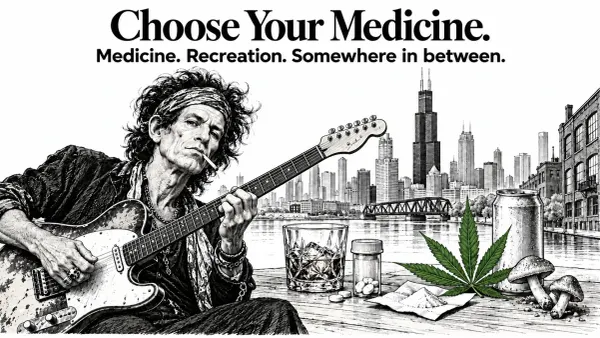
On October 8, 2026, a collection of cannabis entrepreneurs, lawmakers, corporate executives, scientists, comedians, reformers, and assorted pranksters assembled in Chicago to discuss another industry that occasionally appears to be burning down.
Some participants were operating businesses federally classified as illegal. Others were operating federally legal businesses whose principal products face imminent prohibition. Still others were selling products they hope will remain legal long enough to sell something else.
All had legitimate grievances.
So naturally, we called it Festivus.
The morning began with an airing of those grievances. By afternoon, we had assembled representatives of Illinois' licensed cannabis establishment and its entrepreneurial hemp beverage insurgency for a public conversation moderated by POLITICO's Shia Kapos.
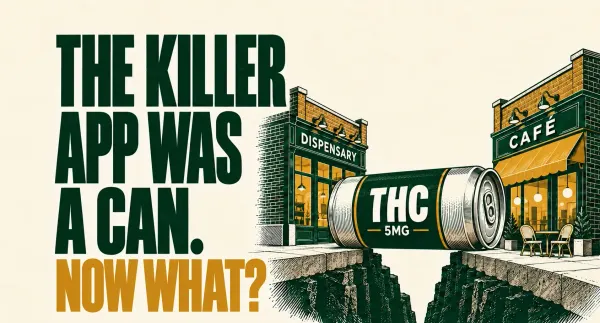
The question wasn't simply who wins and who loses when Illinois' new restrictions arrive November 12.
It was whether Chicago might discover something useful by getting the people who disagree into the same room.
And whether that discovery could become a method.
The cannabis contradiction
Consider the remarkable experiment Illinois has conducted.
We created a heavily regulated cannabis industry, attracted enormous amounts of capital, established national companies, and generated substantial tax revenue.
We also created extraordinary barriers to entry.
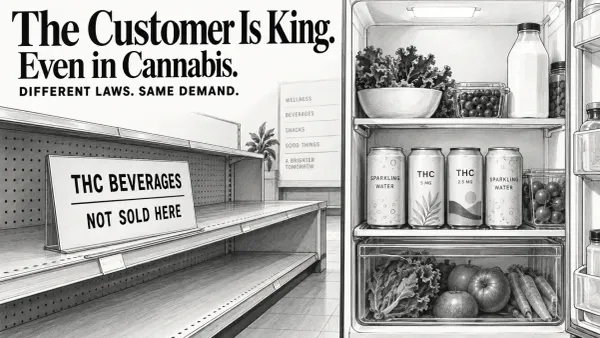
Meanwhile, low-dose THC beverage entrepreneurs found consumers through familiar retail channels: liquor stores, breweries, bottle shops, and neighborhood establishments where people already buy things to drink.
They discovered something that the licensed industry has struggled to achieve.
Cannabis could become ordinary.
Not ordinary in the sense that intoxication is inconsequential. Ordinary in the sense that a consumer could encounter a clearly labeled, low-dose product without navigating a dispensary or embracing an identity as a cannabis enthusiast.
Andrea Slinde of Plift and Perfectly Dosed described the importance of proximity and consumer choice. Laura Jaramillo of nuEra emphasized the considerable investments made by licensed operators to deliver tested products through regulated channels.
Matthew Brewer, a Grasshopper Club dispensary operator and Chicago mayoral candidate, understood both arguments.
His family-owned business had overcome regulatory obstacles that competing hemp retailers never encountered. His brother had previously been arrested for cannabis. When Grasshopper Club finally opened, his brother made its first purchase.
A lovely full-circle story.
Except the circle doesn't pay the bills.
Illinois' attempts at social equity came years after the original license holders established their positions. Newer operators entered a market whose competitive advantages were already deeply entrenched.
Regulation had protected consumers and established legitimate businesses. It had also helped protect incumbents.
Deregulation had encouraged innovation and accessibility. It had also introduced inconsistent standards and competitive imbalances.
Both stories were true.
Which is inconvenient when you are committed to telling only one.
Something happened in the middle
The panel's most intriguing moment wasn't an accusation or a defense.
It was the recognition that licensed cannabis operators and hemp innovators might have considerable reason to work together.
Beverage brands possess consumer relationships, distribution experience, product development capabilities, and a knack for making cannabis approachable.
Licensed operators possess regulatory infrastructure, dispensaries, cultivation and manufacturing capabilities, and considerable experience navigating an extraordinarily complicated business.
Neither side can easily replicate the other's advantages.
Partnerships involving licensing, manufacturing, distribution, and new shopping experiences are already emerging.
Now imagine if public policy actively encouraged responsible collaboration rather than forcing competing constituencies to fight for survival.
Imagine if Chicago developed commercial models that respected public health, protected consumers, rewarded compliance, supported entrepreneurship, and allowed more people to participate.
Imagine, in other words, that the purpose of regulation was to make a marketplace function better.
Crazy talk.
Enter the hallucination
Then Northwestern University artificial intelligence scientist Kris Hammond joined me for a conversation about AI, THC, and whether hallucinations are a feature or a bug.
Kris offered an explanation that might also serve as a diagnosis of American public discourse.
Artificial intelligence systems predict what comes next based on patterns they have encountered.
Sometimes those predictions are wrong. The errors compound. The machine confidently describes things that never happened.
We call these hallucinations.
Humans, Kris argued, also rely on prediction to navigate everyday life.
We expect a door handle to open a door. We expect the check-in table to be near the entrance. We finish each other's sentences.
Our brains continually use context to anticipate what comes next.
Usually, that works beautifully.
Until it doesn't.
Then we sometimes become so attached to our predictions that we mistake them for reality.
At one point, I asked whether hallucinations might actually be a feature, rather than a bug, of both human and machine cognition.
Kris agreed.
The deeper problem isn't that we predict. Prediction makes intelligence practical.
The problem is what happens when we refuse to revise our predictions after encountering contradictory evidence.
Consider what this means for the cannabis industry.
The licensed operator expects the hemp entrepreneur to demand unfair competitive advantages.
The hemp entrepreneur expects the licensed operator to defend an exclusionary system.
The regulator expects a dangerous product.
The consumer expects a refreshing alternative to alcohol.
Everyone arrives with a remarkably detailed understanding of what everyone else is going to say.
And sometimes that understanding is a hallucination.
Chicago, a city of experiments
Here is where Project Middle Ground enters the picture.
For years, I've been interested in what happens when people who know a great deal about something encounter people who know a great deal about something else.
Sometimes nothing.
Sometimes defensiveness.
Occasionally, something remarkable.
The process isn't particularly mysterious.
Get interesting people together. Create enough trust for them to speak candidly. Surface disagreements rather than disguise them. Find the areas where competing interests overlap. Translate the conversation into something useful.
Then give people a reason to act.
This isn't consensus for consensus's sake.
Consensus can be another hallucination.
It's an attempt to make better decisions by creating opportunities for people to discover where their assumptions are incomplete.
Chicago has an unusual opportunity to apply that method to cannabis commerce.
We have national operators, innovative entrepreneurs, research institutions, lawmakers, neighborhood businesses, capital, consumers, and an extensive history of inventing industries that weren't supposed to exist.
What we don't yet have is an enduring mechanism for translating all that experience into a shared commercial and civic agenda.
So why not build one?
Let's develop Chicago Principles for Responsible Cannabinoid Commerce. Let's examine dose, safety, access, equity, consumption, retail innovation, and how cannabis businesses can scale responsibly.
Let's test ideas instead of merely defending positions.
And let's bring some more people into the room who don't know anything about cannabis but know plenty about building businesses, governing cities, protecting consumers, and bringing innovations to market.
There are plenty of reasons this might not work.
We can probably predict most of them.
But after October 8, I'm increasingly interested in what we haven't predicted.
Maybe the real Chicago Way isn't knowing how everything works.
Maybe it's getting enough different people together to discover how things could work better.
We will survive. But perhaps, with a little more intelligence, a little less certainty, and a touch of grace, we might do considerably more than that.