The Customer Is King. Even in Cannabis.

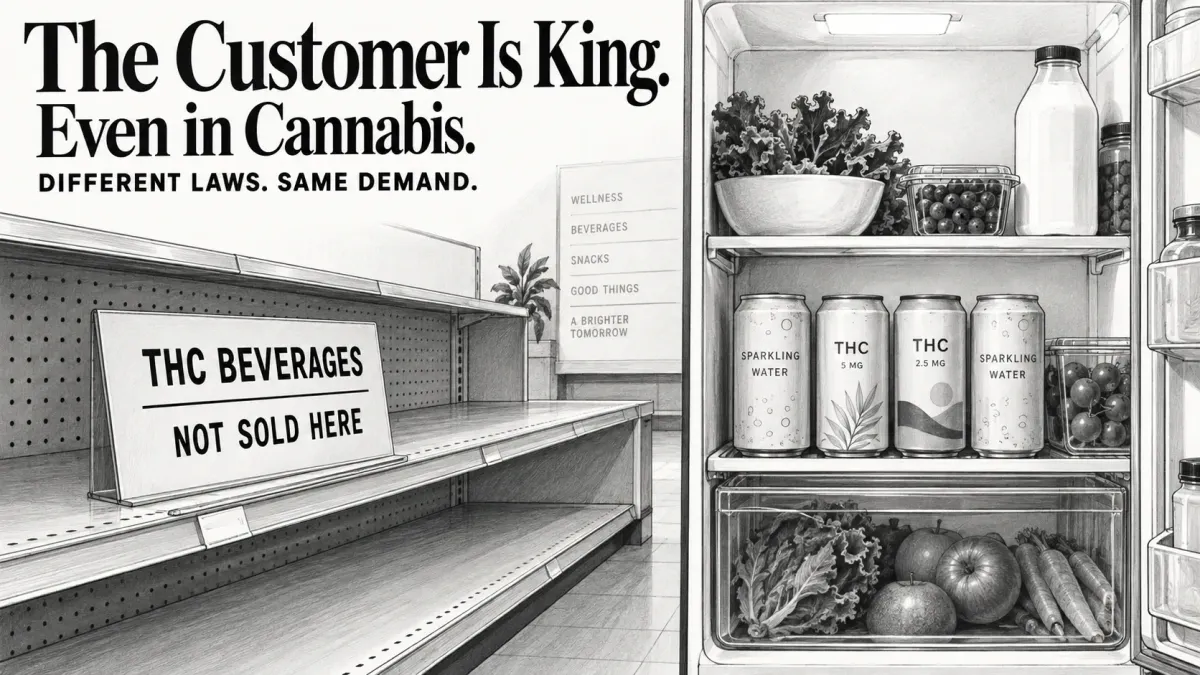
The hemp wars have produced two industries with legitimate grievances. Meanwhile, consumers went ahead and created a market. Maybe it is time to make a deal.
November 12 is still coming.
Just not in quite the same way everywhere.
Congress recently pushed the effective date of new federal hemp restrictions back one month, from November 12 to December 11, 2026. The change gives farmers, manufacturers, retailers and lawmakers another 30 days to argue about what comes next for an industry largely created by the 2018 Farm Bill.
Illinois, however, has its own November 12 deadline.
Under the new Illinois Hemp Act signed this summer, intoxicating hemp products will be reclassified as cannabis and subjected to the state's existing Cannabis Regulation and Tax Act. Outside the licensed medical and adult-use cannabis system, only products containing less than 0.4 milligrams of total THC will remain permitted.
Missouri adds another wrinkle. Most intoxicating hemp products there also move into the regulated marijuana system on November 12. But because of the way Missouri lawmakers wrote the law, hemp-derived THC beverages received the benefit of the federal extension and can remain on ordinary retail shelves until December 11.
Got all that?
Welcome to cannabis.
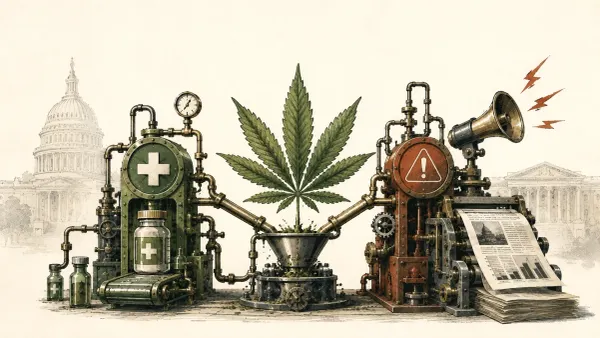
Regardless of where one stands commercially — or, somehow, ideologically — on what critics call the intoxicating-hemp loophole, there are legitimate grievances on both sides.
State-licensed cannabis operators have every reason to look at this marketplace and ask what exactly happened.
They followed the rules.
Then waited for the rules.
Then paid lawyers to interpret the rules.
They raised expensive capital, built secure facilities, endured inspections, paid licensing fees and cannabis taxes, navigated municipal restrictions and, particularly in Illinois, watched years pass while lawsuits and bureaucracy held up licenses people had spent fortunes trying to win.
They did the heavy lifting required to participate in the regulated cannabis market.
Then competitors discovered another road.
Depending on which tribe you belong to, hemp entrepreneurs either ingeniously played by the rules Congress actually wrote in the 2018 Farm Bill or drove a delivery truck through a loophole nobody intended.
Both descriptions contain some truth.
And let's acknowledge something else uncomfortable: plenty of the "opportunists" taking advantage of that market are also licensed cannabis operators, investors and entrepreneurs who would have been foolish to ignore a legal business opportunity sitting directly in front of them.
Capitalism is funny that way.
But while the cannabis tribes spent years fighting over which market was legitimate, something much more consequential happened.
Consumers started buying the stuff.
Particularly beverages.
Cannabis suddenly came in a 12-ounce can.
Consumers brought it to parties. They ordered it at restaurants and bars. They put four-packs in refrigerators. People who might never walk beneath a green cross, enter a dispensary security vestibule or ask a budtender what strain would best accompany dinner discovered cannabis sitting next to beer, sparkling water and nonalcoholic cocktails.
This spring, Target expanded its test of hemp-derived THC beverages into more than 300 stores across Florida, Texas and Illinois, including Illinois locations where local law permitted sales.
Think about that for a moment.
Cannabis spent generations trying to become normal.
Then some of it became something you could toss into the cart during a Target run.
This Market Already Exists
The precise size of the hemp beverage market is frustratingly difficult to establish, which itself tells you something about the regulatory structure we created.
But we can see its physical footprint.
As of September, the THC beverage directory ChillMaps tracks 1,719 Illinois locations offering THC drinks: 449 bars and restaurants and 1,270 stores.
Across the Mississippi River, ChillMaps tracks another 1,054 Missouri locations: 233 bars and restaurants and 821 stores.
That's 2,773 tracked points of sale across Illinois and Missouri alone.
Important caveat: ChillMaps is a commercial directory, not a government census. Those 2,773 locations should not be interpreted as 2,773 businesses that will close, nor even as 2,773 locations certain to lose meaningful revenue. Inventory changes. Some businesses sell lots of THC beverages; others may sell a handful.
But the figure tells us something important.
This category escaped the smoke shop.
It entered liquor stores, restaurants, neighborhood markets, grocery stores and other places where ordinary consumers buy ordinary things.
Missouri provides another indication of the broader scale. A 2025 legislative fiscal analysis used an estimate of approximately 9,000 hemp retailers statewide, while explicitly noting that the number was not limited to hemp beverages and that officials did not know how many of those retailers sold or intended to sell drinks. The legislative document sourced that estimate to reporting by St. Louis Public Radio.
So this is no longer merely a fight between hemp manufacturers and dispensary owners.
It affects distributors.
Restaurants.
Bars.
Liquor stores.
Convenience stores.
Grocers.
Independent retailers.
National chains.
And thousands upon thousands of their customers.
For a business built almost entirely around intoxicating hemp, what happens next may be existential.
For the neighborhood restaurant selling THC drinks alongside burgers, beer and Coke, it may mean losing only one small revenue stream.
For a national retailer such as Target, the calculus becomes simpler still. Cannabis beverages are a microscopic part of the larger enterprise. If continued sales create meaningful regulatory risk, nobody should expect a Fortune 500 company to mount the barricades for hemp.
The product simply disappears from the shelf.
No AI disruption required.
We appear perfectly capable of disrupting this market ourselves.
But What About the Customer?
That's the constituency that seems strangely absent from much of the hemp-versus-marijuana debate.
People like these products.
That does not mean every hemp-derived product deserves to survive.
There have been legitimate concerns about products appealing to children, inconsistent testing, unclear dosing, synthetic cannabinoids, irresponsible packaging and a retail system in which an intoxicating product could sometimes be purchased with dramatically fewer restrictions than recreational cannabis.
Illinois' new law, for example, immediately imposed a 21-and-over requirement and identification checks before the broader November changes arrive.
Regulation isn't the enemy here.
The question is whether prohibition of an existing channel is the only imaginable form of regulation.
Because something else happened while regulators weren't looking.
Consumers learned a new behavior.
They learned that cannabis could be consumed from a can.
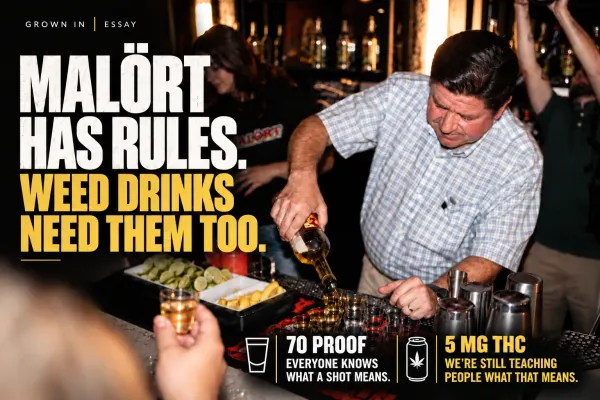
They learned that five milligrams could accompany a Bears game or dinner.
They learned that cannabis didn't necessarily mean smoke, a dispensary visit or getting overwhelmingly high.
Some learned that they preferred it to another beer.
And some people who still carry decades of cultural stigma around "marijuana" apparently became comfortable consuming the exact same plant because somebody put bubbles in it.
That is an extraordinary bit of consumer normalization.
Now imagine explaining to that customer that the product they recently discovered isn't available at the grocery store anymore.
Not because they stopped wanting it.
Not necessarily because the can itself suddenly became more dangerous.
But because Washington, Springfield and Jefferson City are still working out which cannabis regulatory tribe gets to sell what molecule through which door.
Cannabis spent decades asking mainstream consumers to show up.
It should think carefully before telling them they're standing in the wrong line.
Maybe Everybody Gets Something
Which gets us to the opportunity.
The choice does not have to be between the hemp Wild West and pretending this consumer market never happened.
There is at least the outline of a grand bargain here.
Require meaningful product testing.
Require accurate labels.
Require age verification.
Establish reasonable potency and serving limits, particularly for products sold in general retail.
Tax the products.
Police packaging designed to attract children.
Give regulators real enforcement authority against bad actors.
And then confront the question the licensed cannabis industry is right to raise:
How do we recognize the enormous investment made by businesses that entered through the front door?
Maybe businesses that invested in state cannabis licenses receive meaningful advantages in manufacturing, distribution or participation in broader cannabis-product channels.
Maybe licensed craft growers and other smaller cannabis operators receive opportunities to manufacture products for this emerging marketplace.
Maybe existing hemp companies that meet the new standards receive a path into legitimacy rather than an eviction notice.
Maybe restaurants, bars, liquor stores and other age-gated retailers receive licenses to sell clearly defined low-dose products.
Maybe some portion of the significant tax revenue generated by a broader market is directed toward the very social-equity and small-business operators who have struggled most under the existing regulated system.
There are probably a dozen better versions of that structure.
That's the point.
We can regulate a market without pretending it doesn't exist.
The hemp lobby should also recognize reality.
If the political alternative is complete exclusion from a market, there may be value in accepting stricter rules, taxes, dose restrictions and a structure that explicitly recognizes investments already made by state-licensed cannabis operators.
Call it compromise.
Call it capitalism.
Hell, call it equity.
Maybe we can get multiple birds stoned at once.
Rooms of Rivals
None of this means licensed cannabis operators should stop being resentful.
They should bring the resentment.
Hemp entrepreneurs should bring theirs too.
So should the independent retailer wondering why the government is taking a profitable product off the shelf.
So should the craft grower who was promised an opportunity years ago and is still waiting for the economics to work.
So should the MSO.
The beverage manufacturer.
The distributor.
The restaurant owner.
The regulator.
The consumer advocate.
The researcher.
The lawyer.
The investor.
And perhaps most importantly, the actual customer.
Because no one individual, association, company or government agency has all the answers here.
Thankfully, Grown In doesn't pretend to either.
What we can do is get people who normally argue about one another into a room where they have to argue with one another.
That's increasingly what our work in Illinois and Missouri is about.
In October in Chicago, and again as we work with our friends at Cultivated in St. Louis in November, Grown In will be convening operators, entrepreneurs, regulators, retailers, investors, researchers, dissenters, idealists and pragmatists from across these competing cannabis constituencies.
Rooms of rivals.
Consider it a Festivus-inspired airing of cannabis-industry grievances for the benefit of the rest of us.
Because perhaps this isn't simply another chapter in the long cannabis soap opera.
Perhaps it rhymes with the long, messy transition from alcohol prohibition to a regulated legal marketplace — a process that required lawmakers, entrepreneurs and consumers to spend decades figuring out who could manufacture what, who could distribute it, who could sell it, where it could be consumed and how government would tax it.
We're still figuring those things out with cannabis.
But we have agency here.
A beleaguered licensed industry can be strengthened.
Responsible hemp entrepreneurs can have a path forward.
Small businesses that embraced a new consumer category can participate.
Government can regulate and tax it.
And consumers who discovered cannabis precisely because it finally didn't feel like something illicit don't have to be reminded why they avoided it in the first place.
That's a deal worth at least trying to make.
After all, regardless of which cannabis tribe wins the argument, the customer is still king.
Pole optional.