University Hill, 25 Years Later

From eMileHigh to Grown In, the plant-medicine argument finally finds the room
Twenty-five years ago, I smoked pot on University Hill and published a Colorado tech ezine while working around the edges of a young Jared Polis’ world. Today, from the same corner, cannabis, hemp, psychedelics, pharma, state legislatures, and consumer reality are all asking the same question: who builds the room where the future gets sorted out?
Beginning — University Hill, then and now
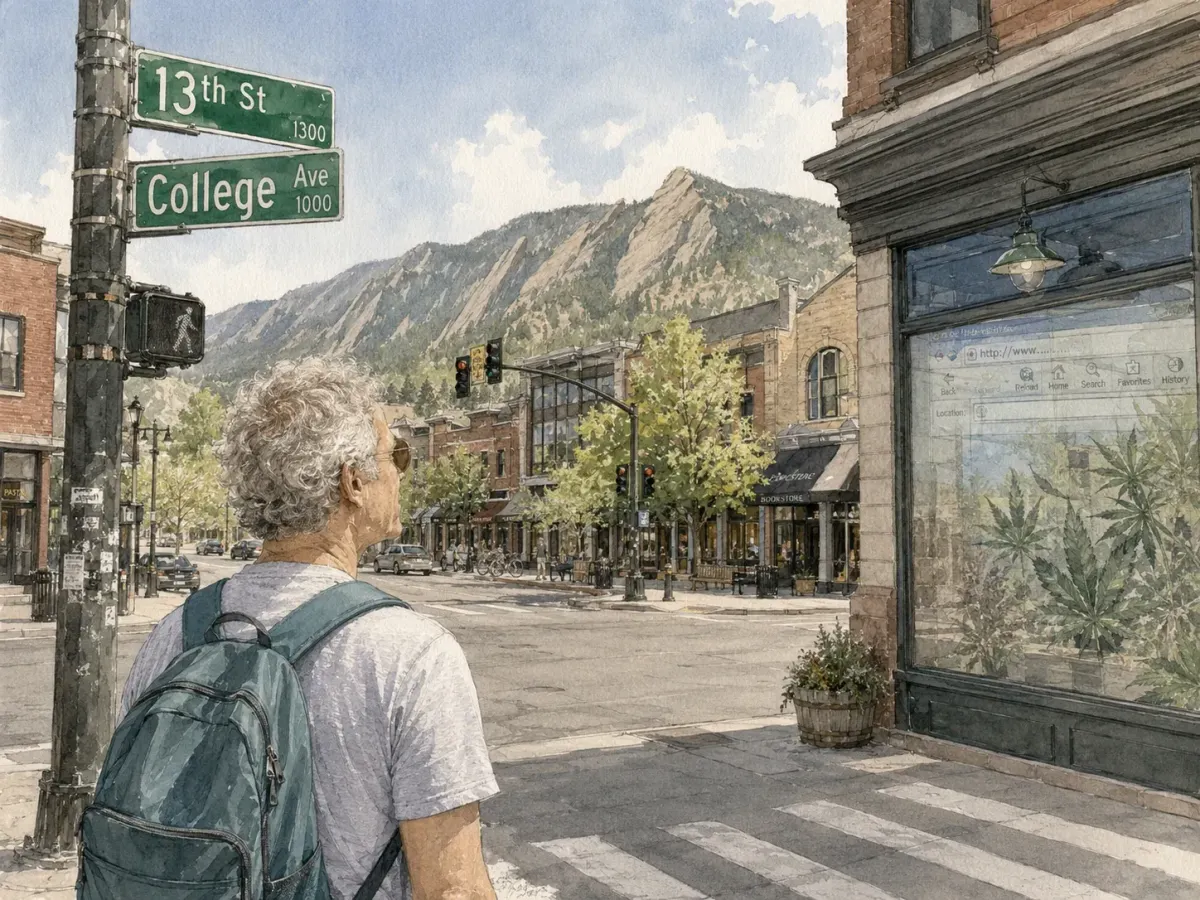
Good morning from University Hill in Boulder, my spiritual home.
I am standing near the corner of 13th and College, looking into the beyond — or at least toward 13th and Euclid, where I lived 25 years ago while working for entrepreneur and Colorado school board member Jared Polis, who would later become a congressman and then governor.
Back then, I was 27 years old, publishing the eMileHigh ezine, smoking pot most mornings, and trying to tell larger stories about technology, culture, business, and civic possibility through prose that was probably too hallucinatory for polite company but somehow useful for the early web.
It was a hit, at least in the way early internet things could be hits before the internet learned to measure everything and understand almost nothing.
There was optimism in the wires then.
Tech was weird, handmade, local, funny, expansive, and still mostly human. The web felt like a new city being built out of words, links, friendships, arguments, and caffeine. We did not yet know how much of it would curdle into robotic hate, surveillance capitalism, algorithmic anxiety, and the slow grinding of attention into dust.
We thought information wanted to be free.
We did not yet understand how expensive free information could become.
This morning, 25 years later, I bought an $8 THCA joint from West Side Smoke Shop. The clerk was cheerful, thoughtful, and quick to point out what has become obvious to almost everyone living inside the market and almost no one writing the rules quickly enough:
Lawmakers are behind.
Not just on cannabis. On plant medicine. On kratom. On kava. On hemp. On synthesized cannabinoids. On tobacco and coffee, too, if we want to be honest about the plant products that have driven both progress and regression for centuries.
He described kratom as potentially useful for addiction recovery and also addictive itself — a double-edged sword. He pointed to chewables that feel something like alcohol. He understood, from behind the counter, that consumers are not waiting for Congress, FDA, DEA, state legislatures, city councils, or the next white paper to tell them what categories these products belong in.
They are experimenting now.
Some thoughtfully. Some recklessly. Some desperately. Some joyfully.
That is the market.
That is also the governance problem.
Middle — The plant-medicine map is moving faster than the law
Here is where the story gets bigger than Boulder.
This week, Eli Lilly — the same pharmaceutical giant riding the Ozempic-era weight-loss and metabolic-drug wave through its own products and market expansion — entered the psychedelic medicine race by agreeing to buy AtaiBeckley in a deal valued at up to $3.8 billion. AtaiBeckley’s lead asset is BPL-003, an intranasal 5-MeO-DMT therapy being developed for treatment-resistant depression.
Lilly, Lilly, Lilly legs.
Blazing Saddles aside, this is not a side story. It is a signal.
The plant-medicine and psychedelic-medicine world has moved from outlaw, to counterculture, to wellness, to investor pitch, to pharma acquisition target. That does not make the science settled. It does not make the access questions easy. It does not make every claim true.
But it does mean the frame has changed.
And in some ways, over the last 25 years, plant medicine has matured more constructively than digital technology did. Cannabis and psychedelics still have hype, fraud, risk, bad actors, overpromising, and cultural confusion. Of course they do. But the best version of the movement still carries a human promise: relief, recovery, pain management, harm reduction, spiritual inquiry, less alcohol, less opioid dependence, more honest conversations about suffering, trauma, healing, and the limits of conventional care.
Information promised liberation and gave us comment-section warfare.
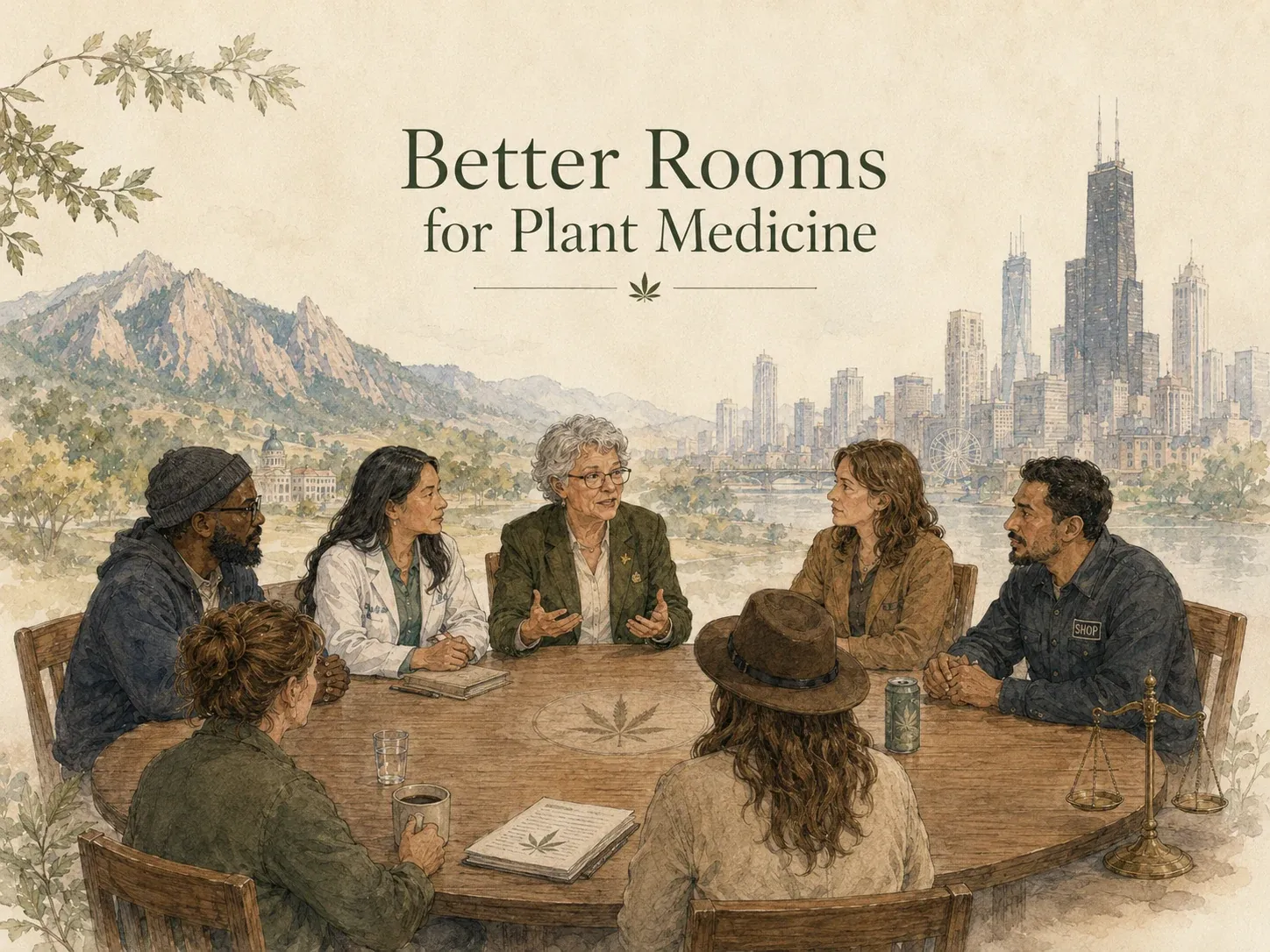
Plant medicine, if handled honestly, may still have a chance to give us better rooms.
That is the phrase that keeps coming back.
Better rooms.
Because the federal level is messy but not irrelevant. Cannabis rescheduling is still moving through DEA process, with hearings scheduled to conclude no later than July 15, 2026, according to DEA’s own public notice. The federal hemp landscape is also facing a hard turn: legal analyses of the 2026 appropriations language describe a coming shift that would make most intoxicating hemp-derived cannabinoid products unlawful, including limits based on total THC and very low per-container thresholds.
That means the real action is not just Washington.
It is the states.
Colorado. Illinois. Minnesota. Michigan, still reeling in the years. Each has a model. Each has scars. Each has operators, patients, consumers, regulators, lobbyists, beverage entrepreneurs, social-equity promises, public-health concerns, and lawmakers trying to separate medicine from marketing, harm reduction from hustle, and legal access from legal loophole.
And in less than two weeks, state legislators from across the country will convene in Chicago for the 2026 NCSL Legislative Summit, July 27–29, bringing together legislators and staff from all 50 states and U.S. territories.
Hello.
Cannabis advocates of every lane will be nipping at their heels: licensed operators, hemp beverage companies, patient advocates, intoxicating hemp defenders, public-health voices, social-equity operators, law firms, pharma-curious plant medicine people, and the usual hallway philosophers who somehow know everything and nothing by lunch.
That is not a criticism.
That is democracy in a crowded hallway.
The problem is that legislators are being asked to process multiple competing messages from multiple constituencies with multiple near-term interests, often filtered through propaganda that has not yet been properly labeled as such.
One side says: shut down intoxicating hemp before kids get hurt and licensed cannabis collapses.
Another says: do not destroy small businesses and consumer products that adults have already chosen.
Another says: beverages are not vapes, not gas-station gummies, not dispensary flower, and should have their own lane.
Another says: all intoxicating THC belongs in the regulated cannabis system.
Another says: FDA will eventually sort this out.
Another says: please stop saying “eventually” while payroll is due Friday.
This is a tug of war.
That is part of the process.
But it is not enough.
End — Build the room before the market builds it badly
So here is the practical invitation from Grown In and Project Middle Ground:
If there is a subset of legislators, regulators, operators, researchers, advocates, retailers, beverage people, medical voices, and civic adults coming to Chicago for NCSL who want an open, off-the-record room to understand the cannabis / hemp / plant-medicine timeline with more honesty and less theater, call Grown In.
Seriously.
We know how to build that room.
Not because we have all the answers. We do not.
Because we know the difference between a panel and a conversation.
Because we know the clock is ticking.
Because nobody is yet speaking clearly enough about the timeline and enforcement methodologies for businesses reliant on CBD turned into intoxication through chemistry, commerce, and loophole law.
When do they have to stop selling?
Who tells them?
What counts as compliant?
What happens to beverages?
What happens to small retailers?
What happens to licensed operators?
What happens to consumers who have already moved from alcohol to THC drinks?
What happens when municipalities, states, federal agencies, investors, insurers, venues, and global markets all look at each other and ask: who is in charge here?
That is the first of several open questions.
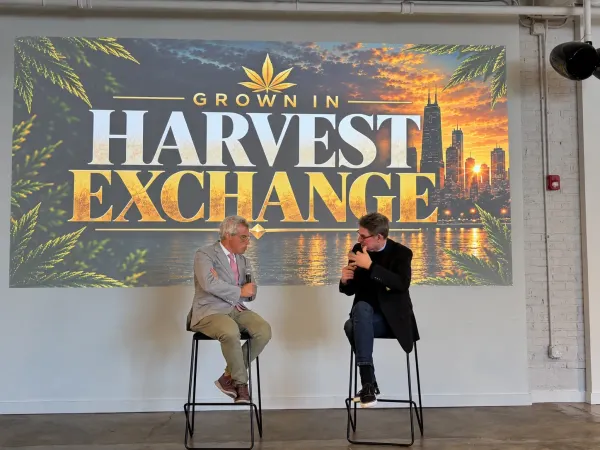
It will be an appetizer for Grown In’s October 8 Cannabis Harvest / Congress in Chicago and the November 12 Midwest Cannabis Forum in St. Louis with our friends at Cultivated.
But the deeper point is 25 years old.
On University Hill in 2001, I thought technology was the room.
It was not.
Technology was the wiring.
The room still had to be built by people.
Today, plant medicine is at a similar moment. Cannabis, hemp, psychedelics, kratom, kava, tobacco, coffee, pharmaceuticals, therapy, recovery, nightlife, medicine, religion, law, commerce, and grief are all standing outside the same door.
Some are smiling.
Some are crying.
Some are lying.
Some are healing.
Some are selling.
Some are regulating.
Some are just trying not to drink tonight.
The future will not be built by pretending those contradictions are not real.
It will be built by honest rooms, trusted conveners, patient questions, differentiated products, compassionate communities, and enough civic humility to admit that the person behind the smoke-shop counter may understand the market better than the person writing the statute.
Twenty-five years ago, I was a young publisher on University Hill, high on cannabis and internet possibility.
Today, I am older, more Chicago, more father, more bruised by what digital became, more grateful for Dylan, more committed to the Middle Ground, and still somehow standing on the same hill asking the same question:
What if the weirdos were right about the future, but wrong about the room?
This time, let’s build the room first.
Then let the plant, the science, the market, the law, and the people find their way through it.
Clean Closing Line
Grown In is not asking everyone to agree.
We are asking the people with agency to enter a better room before the market, the law, and the loopholes make the decision for them.