Chicago via Illinois to the Globe
J.B. Pritzker is Chicago’s accidental Bud Boss. Who inherits the baton?

Act I — The Governor at Sway
The bill is signed. The beverage question is not answered.
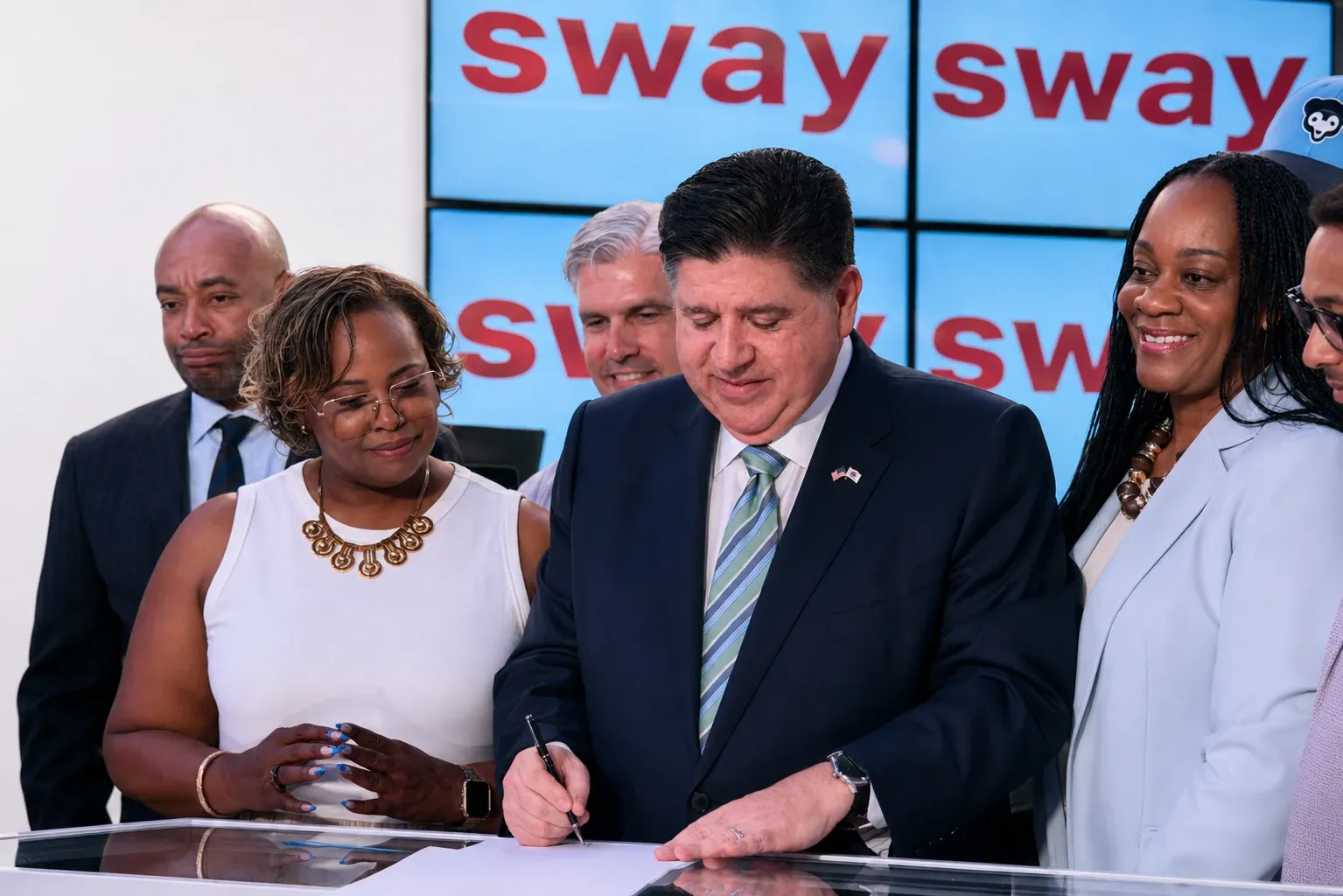
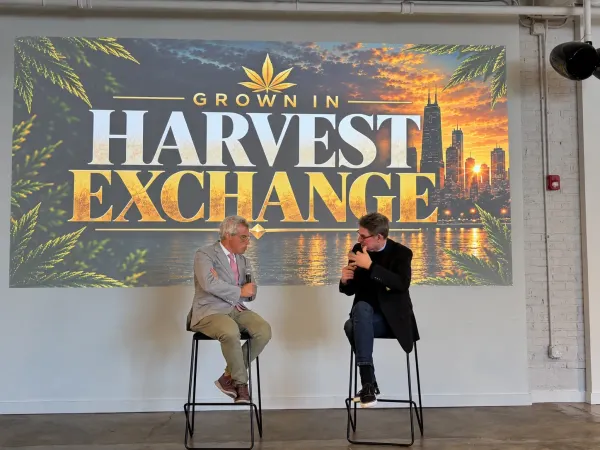
On July 2, in front of a wall that said Sway, Illinois Gov. J.B. Pritzker signed the next chapter of Illinois cannabis policy into law.
It was a good picture.
It was also an unfinished answer.
Grown In asked the governor, directly, what the new law means for hemp-derived THC beverages — the products now sold in restaurants, bodegas, music venues, Navy Pier, the United Center, The Salt Shed, and plenty of other places where consumers seem to have already voted with their wallets.
Pritzker did not give a definitive answer.
More precisely, he indicated he had not read enough on that specific piece of the issue to say what the bill ultimately means for the fate of hemp beverages in Illinois.
That matters.
Because this is not a theoretical category anymore. It is not just a loophole. It is not just Delta-8 gummies at the gas station. It is Senorita on billboards along the Kennedy. It is THC beverages moving through mainstream Chicago venues. It is low/no-alcohol culture meeting cannabis culture meeting beverage distribution meeting federal ambiguity meeting state law meeting local enforcement.
It is also Ben Kovler’s world in two directions at once: Green Thumb Industries as one of the most successful publicly traded cannabis companies born from Chicago, and intoxicating hemp beverages as a consumer breakthrough riding outside the traditional dispensary channel.
So the question is not whether Illinois has taken another step toward regulating intoxicating hemp.
It has.
The question is: who, exactly, is now in charge of deciding what happens next?
If federal Farm Bill reconciliation effectively closes the hemp-derived intoxication loophole, and if federal law translates into state and local enforcement, who in the Pritzker administration tells Navy Pier, The Salt Shed, restaurant groups, retailers, distributors, brands, insurers, investors, and consumers what happens to products they are already buying and selling?
Who tells Senorita what it is allowed to be?
Who tells Chicago venues whether they are ahead of the curve or outside the law?
Who tells small businesses whether they are part of the future of adult beverages or collateral damage in a delayed regulatory cleanup?
And who tells consumers — many of whom are choosing these beverages precisely because they are drinking less alcohol — that a product category they have normalized is now politically inconvenient?
Earlier in the conversation, Pritzker made a broader point that sounded like the governor as institutional chess player: framers play the long game with legislatures.
Fair enough.
But long games still have referees. They still have clocks. They still have consequences for people operating in the present tense.
That is why the Sway signing was not simply a victory lap. It was a transition point.
Pritzker, for now, remains Illinois’ most visible cannabis executive: the governor who implemented adult-use legalization, defended the state’s social-equity promise, welcomed the capital conferences, and now signed a law aimed at bringing intoxicating hemp closer to the regulated cannabis system.
But the beverage question exposed the next layer.
Illinois can pass the law. Washington can close the loophole. Chicago can host the products. Venues can sell them. Consumers can embrace them. Investors can back them. Cannabis companies can hedge both sides.
Then reality asks: how much agency do we actually have?
That question will not stay in Springfield.
By spring 2027, it may be sitting on the next mayor’s desk.
Because Chicago cannabis is no longer just dispensaries. It is medical access, adult use, social equity, intoxicating hemp, beverages, public consumption, hospitality, venues, festivals, room-service edibles, infused desserts, alcohol substitution, research, capital markets, global commerce, and the awkward fact that consumers keep moving faster than government.
Pritzker may be Chicago’s accidental Bud Boss right now.
But even at Sway, with the cameras up and the pens out, the next boss-level question was already visible:
When the loophole closes, who owns the consequences?
And more importantly for Chicago:
Does City Hall merely wait for state and federal law to happen to it — or does it help organize the market that is already here?
Act II — Who Inherits the Bud Baton?
A field guide to Chicago’s next cannabis governing question
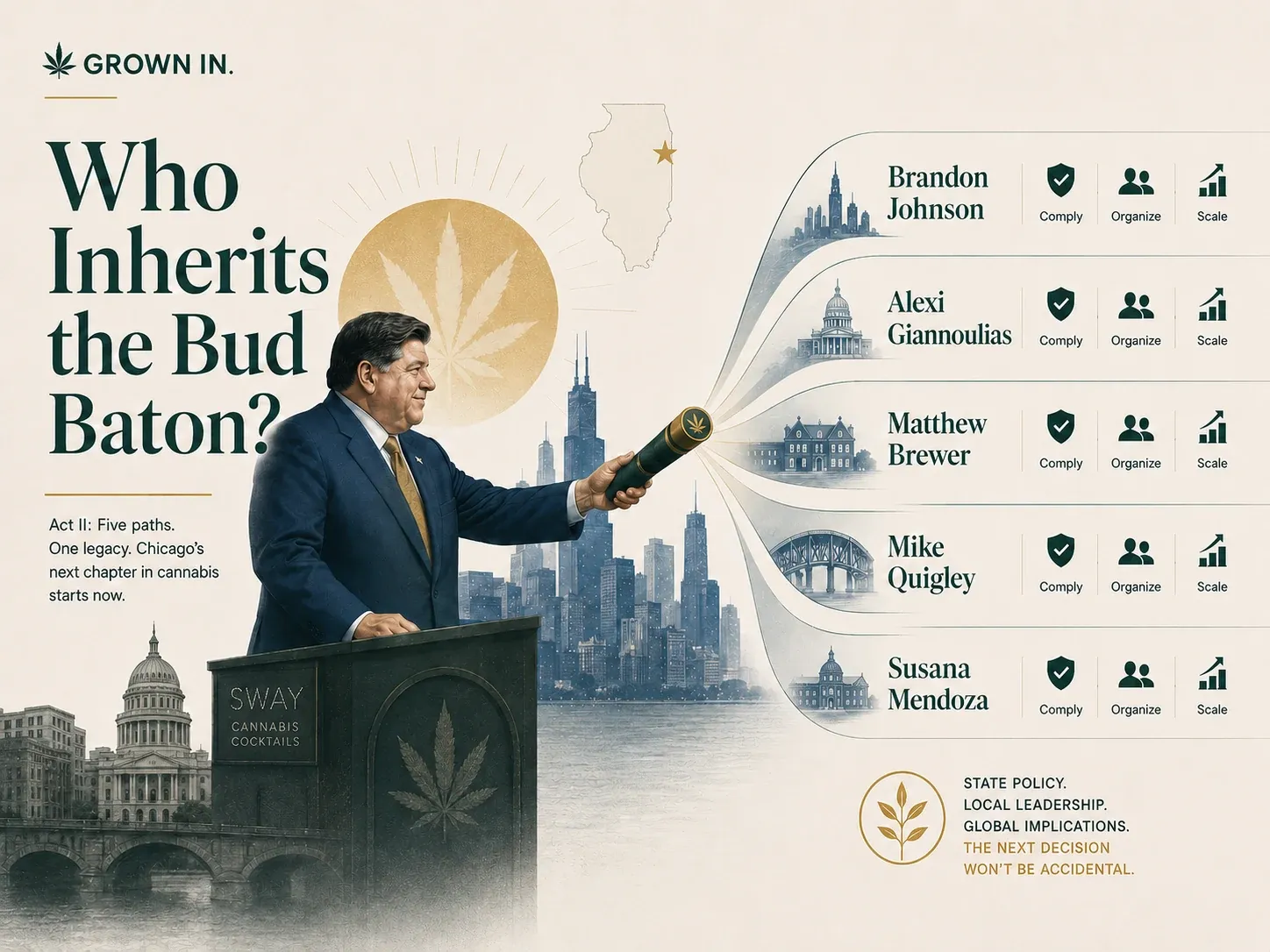
By spring 2027, Chicago may have a new mayor.
The cannabis industry will not wait politely for that person to get briefed.
The beverage market will keep moving. The Farm Bill reconciliation will keep moving. State regulators will keep moving. Venues will keep asking what they can sell. Restaurants will keep watching alcohol trends. Medical patients will keep needing access. Equity operators will keep trying to survive. Investors will keep looking for clarity. And consumers — as usual — will be several steps ahead of law.
So the useful mayoral cannabis question is not: Who likes weed?
That is the wrong question.
The better question is:
Who can comply, organize, and scale a cannabis economy that is already here — and increasingly global?
That is where the current and emerging field gets interesting.
Not because any of these candidates are likely to run as the “cannabis mayor.” They are not. Nor should they, necessarily.
But because cannabis now touches too many of Chicago’s live wires to be treated as a niche issue: public health, policing, hospitality, retail, taxation, neighborhood development, research, equity, banking, food and beverage, tourism, music venues, sports venues, capital markets, and Chicago’s broader economic-development story.
Here is the field guide.
1. Brandon Johnson — The incumbent with an unfinished cannabis economic-development story
Mayor Brandon Johnson did not create Chicago’s cannabis economy.
He inherited one.
And in many ways, cannabis should fit naturally inside the best version of his governing argument.
Johnson’s community-first agenda — whatever one thinks of the politics around it — has a real civic logic: protect neighborhoods, lift up working people, support small businesses, rebalance power, and make sure economic development is not only something that happens downtown, after the insiders have eaten.
Cannabis is almost tailor-made for that frame.
It includes neighborhood retailers. Social-equity licensees. Black and Brown operators. Labor. Public health. Youth protection. Criminal-justice repair. Medical access. Consumer safety. Small businesses selling hemp-derived products. Publicly traded companies with Chicago roots. Thousands of employees. Thousands more in law, finance, insurance, marketing, real estate, construction, logistics, security, software, research, compliance, and hospitality.
It is both a community-development issue and a global-commerce issue.
To be fair, World Business Chicago and the broader civic ecosystem have already done useful work describing Chicago’s cannabis assets: MSO headquarters, professional services, research capacity, talent, and the city’s position as a serious hub for a still-forming industry.
But the industry has changed quickly.
The next chapter is not only “Chicago is home to big cannabis companies.”
It is hemp beverages. Public consumption. Hospitality. Social-equity survival. Medical access. University research. Venues. Alcohol substitution. Federal uncertainty. Capital access. Public-health guardrails. International markets. And the possibility that Chicago can become an application city for legal cannabis in the same way it has been an application city for food, finance, logistics, insurance, consulting, and health care.
Johnson does not need to become the cannabis mayor.
But if his community-first agenda is serious — and history may treat parts of it more kindly than today’s politics do — cannabis is one of the places where that agenda can be made more practical, more visible, and more economically durable.
The opportunity is not to scold City Hall or World Business Chicago.
It is to help them update the frame.
Grown In’s question for Johnson:
Can Johnson’s City Hall and World Business Chicago update Chicago’s cannabis story from “home of major operators” into a community-first strategy that also supports equity operators, small businesses, medical access, research, venues, beverages, professional services, and global commerce?
2. Alexi Giannoulias — The fluent establishment contender who has not yet shown his cannabis hand
Alexi Giannoulias is not officially in the race.
But Chicago business people are already treating him like a serious possible mayor.
That matters because cannabis, at this stage, is no longer only a reform issue. It is an executive-function issue. It rewards people who can speak across regulated industries, banks, real estate, law firms, hospitality, labor, civic organizations, Springfield, Washington, and neighborhood politics without sounding either terrified or unserious.
Giannoulias has the profile for that kind of conversation: statewide experience, private-sector fluency, Obama-era Chicago connections, telegenic discipline, and a political fund large enough to make people pay attention.
His cannabis record is less clear.
That is not automatically a weakness. In some ways, it makes him a useful test case for the next phase of Chicago cannabis politics. The old question was whether a candidate supported legalization. The new question is whether a candidate understands what legalized cannabis becomes after legalization.
The Hanah Jubeh connection is relevant here as a bridge signal, not a gotcha. Her cannabis relevance is not that she has been known publicly as a cannabis advocate in the Ameya Pawar sense. It is that she was part of an early Chicago political-commercial universe that helped make cannabis sound respectable: union-friendly, wellness-coded, social-equity-branded, hospitality-oriented, and connected to serious local operators.
That is the exact tone the next mayor will need.
Not stoner cosplay.
Not moral panic.
Fluency.
Comfort.
A sense that cannabis belongs somewhere in the grown-up Chicago economic-development conversation.
Grown In’s question for Giannoulias:
Would a Giannoulias City Hall treat cannabis as a serious regulated growth sector — connected to finance, logistics, hospitality, health care, food, beverage, research, and global commerce — or keep it safely outside the mayoral brand?
3. Matthew Brewer — The operator who knows the industry from the inside
Matthew Brewer is different.
He does not merely have opinions about cannabis. He has operated near the hard parts.
Through Grasshopper, one of Illinois’ more visible Black-owned dispensary platforms, Brewer brings something most mayoral candidates do not: direct familiarity with the realities behind the ribbon cutting.
Cannabis retail is not just branding. It is real estate, licensing, security, banking limitations, inventory, supplier relationships, tax pressure, community expectations, neighborhood politics, capital constraints, and the daily discipline of serving consumers inside a market that still does not behave like normal retail.
That is a credential.
It is also a complication.
Because once you know the industry from the inside, you know the parts that do not fit neatly on a campaign website. Payment timelines. Supplier friction. Uneven power. Regulatory drag. The weird economics of selling a legal product that remains federally illegal. The gap between social-equity rhetoric and operating reality.
That does not make Brewer weaker. It potentially makes him more useful.
Chicago does not need a mayor who can recite cannabis slogans. It needs one who understands the operating system.
Brewer’s broader civic profile — CHA experience, legal background, neighborhood and ownership lens, and direct cannabis exposure — could let him speak to the industry in a way that feels less borrowed than most candidates.
The question is whether that industry fluency scales into a citywide governing framework.
Grown In’s question for Brewer:
Can an operator-politician translate lived cannabis knowledge into a citywide strategy that serves equity operators, suppliers, workers, neighborhoods, venues, consumers, researchers, and investors — not just the part of the market he already knows?
4. U.S. House Rep. Mike Quigley — The federal plumbing candidate
Mike Quigley’s cannabis lane is not culture.
It is plumbing.
Banking. Federal prohibition. Capital access. Public safety. Institutional normalization. The gap between state legality and federal illegality.
That is not sexy. It is also the reason cannabis businesses spend so much time explaining why normal business tools do not work normally for them.
Quigley has the clearest federal reform lane in the group. He can talk about SAFE Banking, cash risk, lending, capital formation, federal-state conflict, and the absurdity of asking legal businesses to operate under semi-illegal infrastructure.
That gives him credibility with law firms, banks, insurers, real estate groups, capital markets, public safety voices, and operators who want cannabis to become boring enough to finance.
His limitation is that federal fluency is not the same as Chicago imagination.
A mayor cannot pass SAFE Banking alone. But a mayor can organize a city’s institutions around the reality of federal blockage. A mayor can convene banks, universities, venues, hospitals, operators, law firms, and investors. A mayor can make Chicago a serious home for state-legal businesses even while Washington remains slow, conflicted, or performative.
Quigley’s lane is the most institutional.
The question is whether he would turn that into a Chicago-specific cannabis strategy, or leave it in the federal-reform file.
Grown In’s question for Quigley:
How would he use the mayor’s office to make Chicago a serious home for state-legal cannabis businesses while federal law still blocks banking, capital, research, taxation, and interstate commerce?
5. The order-and-commerce lane — Mendoza, Cardenas, Holberg and the mainstream governing question
Not every serious candidate will have a deep cannabis record.
That is fine.
But every serious candidate should have a cannabis governing posture.
For the likely order-and-commerce lane — figures such as Susana Mendoza, Gil Cardenas, and public-order candidates such as Holberg-type entrants depending on the field — cannabis becomes a test of whether “restore order” can coexist with modern commerce.
That is a legitimate test.
People should not have to sit in cannabis smoke on public transportation. Parents should not have to guess what is being sold to minors. Neighborhoods should not have to decode state, city, and federal contradictions. Restaurants should not have to wonder whether a THC beverage menu creates legal exposure. Venue operators should not need a lawyer on retainer to decide what adults can drink during a concert.
Order is not the enemy of cannabis.
Confusion is.
And confusion is what Chicago will get if City Hall treats cannabis as someone else’s issue.
The order-and-commerce candidate has a real opportunity here: speak plainly about public spaces, age gates, storefronts, tax revenue, hospitality rules, enforcement consistency, and consumer clarity — without sounding like legalization was a mistake.
That lane may not produce the most poetic cannabis vision.
But it could produce the most administratively useful one.
Grown In’s question for this lane:
Can “restore order” become something more sophisticated than restriction — a framework for legal commerce, clear rules, neighborhood comfort, public-health guardrails, and Chicago-scale market growth?
Act III — The Questions Chicago’s Next Bud Boss Must Answer
A Grown In civic checklist for the 2027 mayoral field
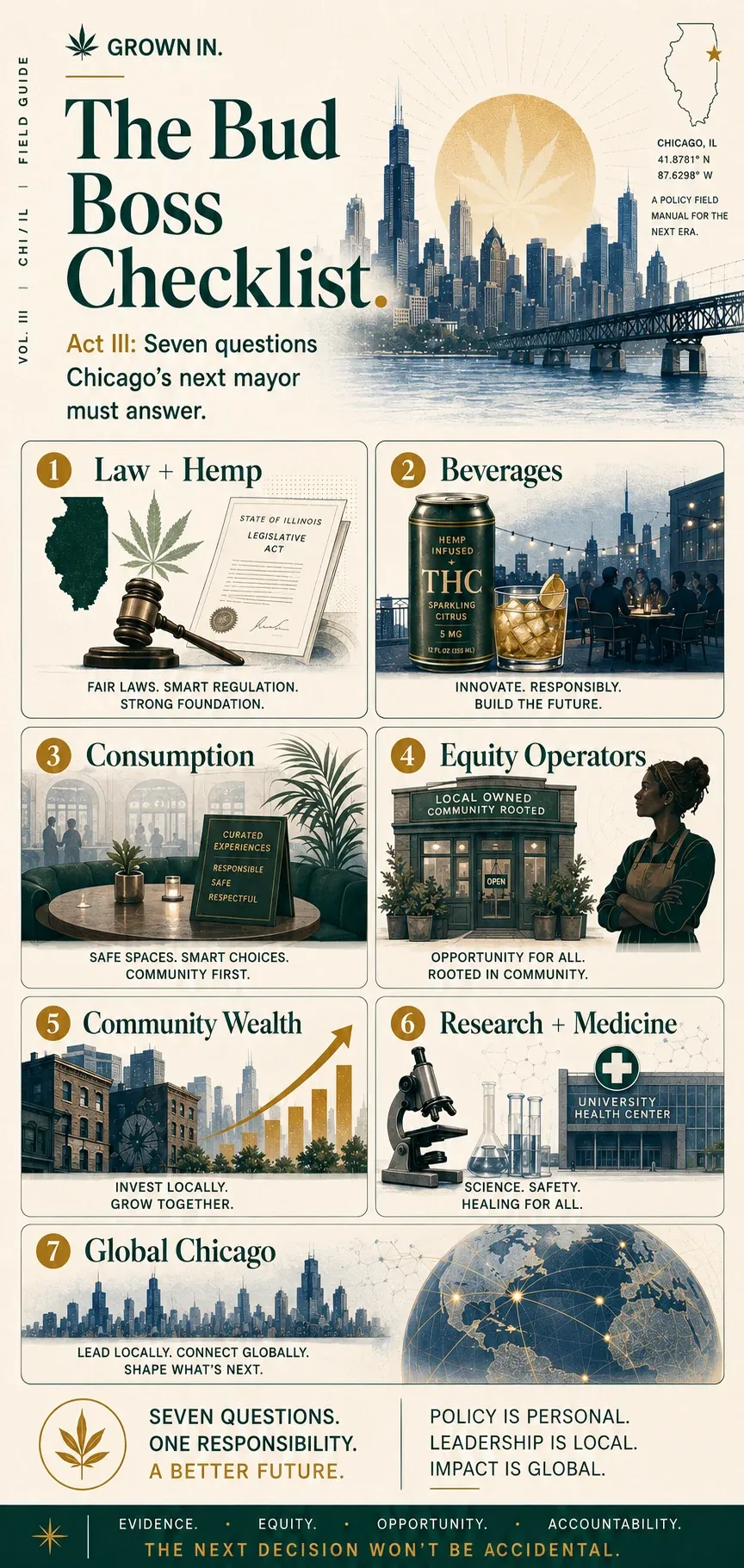
Chicago does not need every mayoral candidate to become a cannabis evangelist.
It does need every serious candidate to understand that cannabis is no longer just dispensaries.
It is medicine. It is adult use. It is intoxicating hemp. It is beverages. It is public consumption. It is youth access. It is venue policy. It is restaurant policy. It is research. It is banking. It is capital. It is social equity. It is policing. It is professional services. It is tax revenue. It is global commerce.
It is also a Chicago story.
So Grown In’s ask is simple: before this race hardens into slogans, let’s level-set the issue.
Not as industry cheerleading.
Not as culture war.
Not as moral panic.
As governance.
1. Where do you stand on the new Illinois cannabis / hemp framework?
Do you support the direction of the law Gov. Pritzker signed at Sway?
Do you believe intoxicating hemp products should be brought inside a regulated structure similar to cannabis?
Do you support age-gating, product testing, labeling, and enforcement?
And most importantly for Chicago: when state and federal law collide with the beverage market already operating in restaurants, venues, bodegas, Navy Pier, The Salt Shed, the United Center, and beyond, what should the mayor’s office actually do?
Not philosophically.
Operationally.
2. What happens to THC beverages?
This is the live wire.
Consumers have already normalized cannabis beverages faster than lawmakers have categorized them.
They are showing up where low/no-alcohol culture, wellness language, nightlife, music venues, CPG experimentation, hemp law, cannabis law, and alcohol distribution all collide.
The city needs clarity before clarity is forced on it.
Are THC beverages part of Chicago’s hospitality future?
Should they be sold only through licensed cannabis channels?
Can restaurants and venues participate compliantly?
What happens if federal Farm Bill reconciliation narrows or ends the hemp-derived intoxicant lane?
And who tells the businesses already operating what comes next?
3. What is Chicago’s public-consumption strategy?
If Chicago can regulate liquor licenses, rooftop bars, tasting menus, sports books, music festivals, tailgates, and late-night entertainment districts, it can at least have a serious adult conversation about compliant cannabis consumption.
That does not mean anything-goes.
It means clarity.
Medical access. Adult-use hospitality. Pop-ups. Elegant edibles. Infused desserts. Venue pilots. Festival rules. Private events. Hotel and tourism questions. Neighborhood comfort. Public-health guidance. Police clarity. Insurance clarity. Landlord clarity.
The current ambiguity serves almost no one.
4. How will Chicago support equity operators after licensing?
The social-equity promise does not end when a license is awarded.
In some ways, that is when the harder part begins.
Real estate. Security. Financing. Tax pressure. Inventory. Supplier relationships. Payment timelines. Permitting. Marketing. Community trust. Workforce. Compliance. Competition from better-capitalized players.
Chicago’s next mayor should be able to explain how the city will help equity operators survive, professionalize, and scale — without reducing them to ribbon-cutting symbols.
5. How does cannabis fit into community-first economic development?
This is the Johnson / WBC bridge, but it applies to everyone.
Chicago’s cannabis assets already include major operators, neighborhood dispensaries, social-equity licensees, professional services, tech providers, researchers, workers, venue operators, beverage entrepreneurs, medical advocates, and consumers.
The question is whether City Hall can organize those assets into a civic strategy.
Cannabis can be community wealth.
Cannabis can be workforce.
Cannabis can be research.
Cannabis can be hospitality.
Cannabis can be tax base.
Cannabis can be global trade.
But not if it is treated only as a problem to manage after someone complains.
6. What is Chicago’s research and medical cannabis agenda?
The Cannabis Research Institute gives Chicago and Illinois a serious platform.
That matters because cannabis policy is still being made in a fog: federal illegality, limited research, uneven public understanding, stigma, commercial hype, patient need, and inconsistent product knowledge.
Chicago should be one of the places where that fog lifts.
What role should UIC, hospitals, universities, medical operators, patient advocates, public-health officials, and state regulators play?
How can Chicago help move cannabis from anecdote to evidence without losing sight of access, equity, and commercial reality?
7. What is Chicago’s global cannabis story now?
The first version was simple and credible: Chicago is home to major MSOs and the lawyers, accountants, consultants, insurers, landlords, marketers, bankers, and tech providers who serve them.
That story still matters.
But the next story is bigger.
Chicago is an application city.
We may not grow the most cannabis. We may not have the loosest culture. We may not be the first mover on everything.
But Chicago knows how industries become systems.
Food. Finance. Logistics. Insurance. Health care. Hospitality. Law. Consulting. Data. Universities. Conventions. Associations. Global relationships.
That is where cannabis is going.
So the mayoral question is not whether Chicago is a cannabis city.
It already is.
The question is whether Chicago becomes a serious global cannabis application city — or merely a place where the industry happens to rent office space.
Closing
The next mayor of Chicago does not have to be a cannabis candidate.
But the next mayor does have to know what time it is.
The plant is legal, illegal, medical, recreational, intoxicating, therapeutic, overtaxed, underbanked, overhyped, under-researched, locally sold, federally constrained, culturally normalized, commercially global, and politically unfinished — all at once.
That sounds like a mess.
It also sounds like Chicago.
And if Chicago is serious about being more than a headquarters town for cannabis companies, then the next Bud Boss needs to answer one simple question:
Will City Hall merely tolerate the cannabis economy — or help organize it into something worthy of Chicago, Illinois, and the globe?