Cannabis Needs Festivus

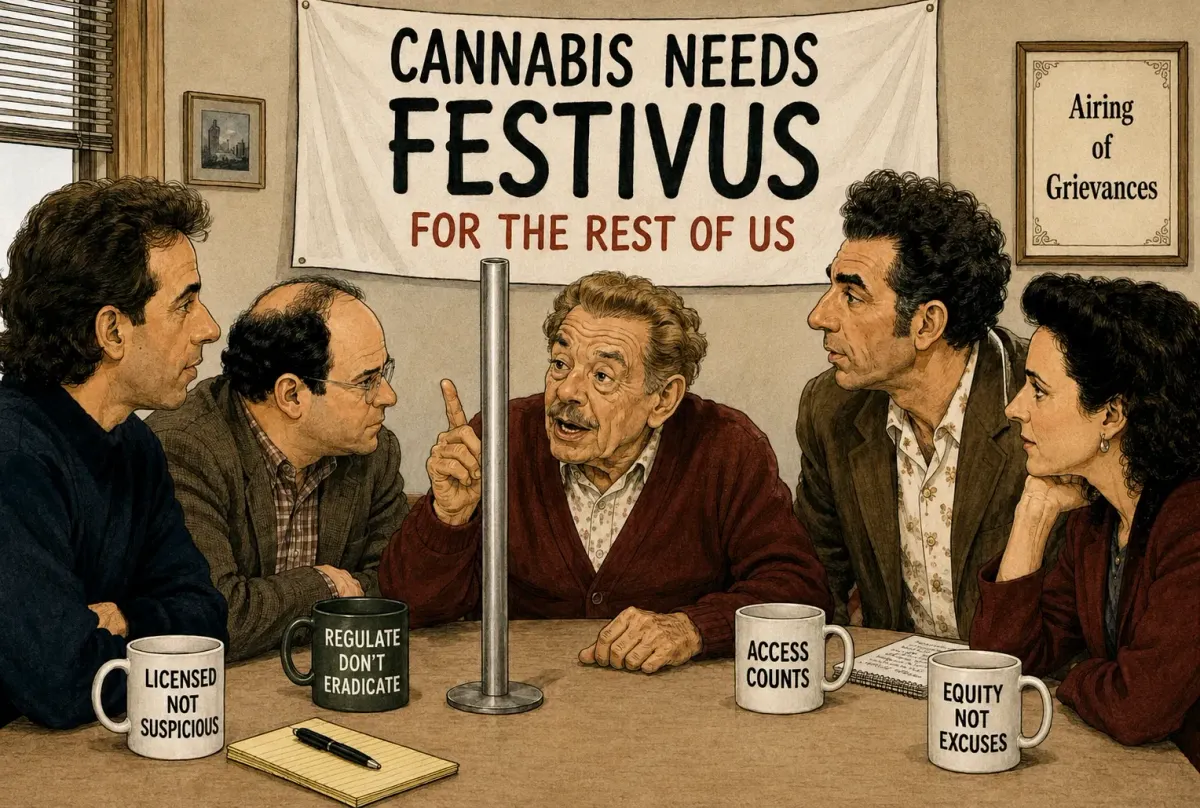
Frank Costanza was right.
Not just about the pole. Not just about the tinsel. Not just about the sacred obligation to tell your family exactly how they have disappointed you over the past year.
He was right about the structure.
Every functioning family under a big enough tent eventually needs an airing of grievances.
The Costanzas needed one. The Seinfeld universe needed one. America probably needs one. And the cannabis industry — in the United States, across North America, and maybe around the world — absolutely needs one.
Because cannabis is a family now.
A weird family. A wounded family. A federally illegal, state-regulated, hemp-adjacent, conference-sponsored, tax-burdened, stigma-haunted, over-lawyered, under-capitalized family.
But a family.
And families that pretend they do not have grievances do not become healthier. They just get quieter, stranger, more passive aggressive, and eventually someone throws a plate.
So yes, this week, in the spirit of peace, love, fun shit, and commercial survival, cannabis needs Festivus.
Festivus for the rest of us.
A pole in the middle of the room. No tinsel. Tinsel is distracting.
And then, one by one, everyone gets to say what everyone else already knows.
Licensed cannabis operators have grievances with intoxicating hemp, especially on the beverage side.
Hemp beverage companies have grievances with licensed cannabis operators and a regulatory framework that often seems designed to preserve one lane while casting suspicion on another.
Large incumbent operators have grievances with a market that has punished scale, crushed margins, complicated capital, and made survival feel like a policy argument.
Small operators, especially those formed under social equity regimes, have grievances with large incumbents who talk about survival while the smaller players wonder whether they ever had a real shot in the first place.
Regulators have grievances with legislators, courts, administrative limits, agency design, and everyone who thinks a cannabis office can wave a wand over statutory ambiguity.
The industry has grievances with regulators who can somehow be central enough to convene, symbolize, message, and celebrate cannabis policy, while also being peripheral enough to say the hardest problems are out of their hands.
Conference sponsors have grievances because they paid real money and want real ROI.
Conference organizers have grievances because convening this industry can be financially irrational bordering on self-harm.
Service providers have grievances because they are often asked to build the strategy, write the memo, make the introduction, explain the market, work the room, discount the invoice, wait for payment, and then watch someone draft off their platform to launch a competing event.
Everyone has grievances because everyone is struggling to get paid.
That is the part that makes cannabis different from normal industries. In normal industries, when people say “we are all in this together,” they are usually lying. In cannabis, they are often telling the truth, but only because federal illegality, stigma, banking complications, punitive tax treatment, uneven enforcement, bad capital markets, legacy trauma, and state-by-state fragmentation have created a circular firing squad where the bullets are invoices.
So let us stop pretending this is a Thanksgiving dinner where everyone is grateful and well-behaved.
It is Festivus.
For the rest of us.
The first grievance is licensed cannabis versus intoxicating hemp.
This is not merely a policy fight. It is a moral status fight disguised as a policy fight.
Licensed cannabis says: We followed the rules.
Hemp says: You followed rules written to protect people who could afford to follow them.
Licensed cannabis says: We invested under a regulated framework.
Hemp says: Consumers do not care about your framework.
Licensed cannabis says: We are tested, tracked, taxed, and inspected.
Hemp says: You are also expensive, inconvenient, and sometimes bad at making products people want to buy outside a dispensary.
Licensed cannabis says: Public health, consistency, and accountability matter.
Hemp says: Access, convenience, and consumer choice matter too.
Licensed cannabis says: Loophole.
Hemp says: Monopoly.
Somewhere in the middle is the consumer, who may not know the difference between hemp-derived THC and marijuana-derived THC, but does know whether the drink tasted good, whether it worked, whether it was easy to buy, and whether the person lecturing them sounded like they were protecting public health or protecting a margin.
The second grievance is inside the licensed market itself.
This one hurts more because it is less fun to talk about.
Large operators are not cartoon villains. Many are financially bruised, publicly battered, operationally complex companies trying to survive a market that has punished nearly every projection made during the green rush. They employ people. They pay taxes. They built stores, grows, brands, labs, logistics, compliance systems, and political relationships in an environment where the federal government still treats the plant as illegal.
But small operators are not naïve children who should have known better. Many were told, directly or implicitly, that legalization would create generational opportunity. They believed in the promise of social equity because the promise was made loudly. They won licenses that sometimes functioned less like golden tickets than like expensive options to enter a capital-starved maze.
They faced real estate clocks, investor demands, municipal uncertainty, buildout costs, product access issues, and market concentration before they ever had a chance to compete.
So when larger operators say, “We need relief to survive,” smaller operators hear, “We need permission to crush you faster.”
And when smaller operators say, “We never had a shot,” larger operators hear, “You want a subsidy for not being able to operate.”
Both sides are tired of being caricatured.
Both sides have facts.
Both sides have blind spots.
Both sides have lawyers.
That is why this requires Festivus. Not because Festivus solves the problem, but because it forces the family to admit the problem exists before dessert.
The third grievance belongs to the regulators, although they may not enjoy hearing it described that way.
Regulators are not magicians. They cannot invent statutory authority. They cannot always fix what legislators wrote, what agencies inherited, what courts delayed, or what capital markets destroyed. They are often understaffed, over-scrutinized, and trapped between public health, political pressure, industry anger, and administrative law.
Fine.
But the regulated industry is equally tired of being told that every painful outcome lives somewhere else.
At some point, “not our authority” begins to sound less like a legal explanation and more like a governing philosophy. If an office helps symbolize cannabis policy, convenes around cannabis policy, communicates cannabis policy, and benefits from the public perception that someone is steering cannabis policy, then people will reasonably ask what happens when the steering wheel comes off.
Ownership caps are a perfect Festivus grievance because they combine everything cannabis does badly: statutory ambiguity, market concentration, social equity anxiety, incumbent strategy, legal interpretation, administrative caution, and years of people saying the same thing in different rooms while nothing quite resolves.
The fourth grievance is the conference economy.
Cannabis events are where optimism goes to network with accounts receivable.
Everyone knows the choreography. The sponsor wants decision-makers. The organizer wants sponsorship checks. The speaker wants status. The journalist wants a story. The consultant wants clients. The operator wants capital. The regulator wants to seem accessible without accidentally saying anything. The attendee wants all of the above plus a decent lunch.
And somehow, after two days of panels, a VIP dinner, a rooftop thing, and a networking breakfast where nobody eats the yogurt, everyone leaves wondering whether the event worked.
The sponsor did not get enough ROI.
The organizer did not get enough paid tickets.
The startup did not get enough investors.
The journalist did not get enough news.
The lobbyist did not get enough urgency.
The social equity operator did not get enough introductions that mattered.
The service provider got just enough information to build a competing event next quarter.
Airing this grievance does not mean conferences are bad. Convening matters. In cannabis, it matters more than in most industries because the market is fragmented, the rules are incoherent, and institutional trust is thin.
But the industry needs to be more honest about the economics of gathering.
Somebody pays for the room.
Somebody monetizes the room.
Somebody is the room.
The fifth grievance is Thanksgiving.
Yes, Thanksgiving.
Because apparently we have reached the stage where serious adults are dressing down other serious adults for believing hemp beverages might survive into the holidays.
Maybe they will. Maybe they will not. Maybe the category gets regulated into dispensaries. Maybe it gets routed through liquor. Maybe it gets capped, taxed, age-gated, litigated, consolidated, or strangled by federal language written by people who could not identify a five milligram seltzer if it was served to them at a fundraiser.
But the contempt is the thing.
Cannabis has always had a strange relationship with belief. For decades, belief was necessary. Belief that legalization could happen. Belief that patients deserved access. Belief that adults should not be arrested. Belief that people harmed by prohibition should participate in legalization. Belief that capital would arrive. Belief that the rules would normalize. Belief that federal reform was just around the corner.
Now, after years of disappointment, belief itself has become embarrassing.
People who once sold billion-dollar visions now mock anyone who thinks a new category might survive the holidays.
That is not sophistication.
That is trauma wearing a blazer.
The industry does not need blind optimism. It has had plenty of that. It needs disciplined realism without the smug pleasure some people take in watching other people’s hopes get smaller.
Which brings us back to Festivus.
The point of airing grievances is not to win the room. It is to clear enough space for the family to keep functioning.
Cannabis is a family business, even when the family is publicly traded.
It has old heads and new money, activists and accountants, regulators and rogues, beverage people and flower people, social equity founders and multistate operators, lobbyists and lawyers, journalists and sponsors, patients and tourists, legacy operators and LinkedIn prophets who discovered the plant after their last SaaS company stalled.
It is messy because it contains everyone who was right too early, everyone who arrived too late, everyone who paid too much, everyone who was promised too little, and everyone who still has to make payroll.
So give cannabis a Festivus.
Let the licensed operators air their hemp grievances.
Let the hemp beverage people air their dispensary grievances.
Let the social equity operators air their incumbent grievances.
Let the incumbents air their survival grievances.
Let the regulators explain where their authority begins and ends, and then let the industry explain why that answer is no longer enough.
Let sponsors say what they actually need.
Let organizers say what things actually cost.
Let service providers admit when they are convening, selling, reporting, lobbying, researching, and prospecting at the same time.
Let everyone say the quiet part: we are all trying to get paid in an industry that still makes getting paid unnecessarily hard.
And then, when the grievances are done, we can move to the feats of strength.
Not wrestling Mr. Costanza to the floor.
Something harder.
Writing rules that consumers can understand.
Building markets where small operators can actually operate.
Regulating hemp without pretending beverages are fentanyl.
Protecting public health without protecting incumbency.
Letting licensed cannabis compete without making compliance a punishment.
Paying conference organizers for the value of the room.
Paying service providers before they become creditors.
Letting sponsors measure ROI without turning every gathering into a trade-show hostage situation.
Letting regulators say “we need the legislature” without using that sentence as a trap door.
Letting the industry argue without confusing disagreement for betrayal.
That is what functioning families do under big tents.
They do not agree on everything. They do not pretend the grievances are fake. They do not confuse politeness with peace.
They sit at the table. They name the conflict. They survive the meal.
And if they are lucky, they find a way to come back next year.
Cannabis has grievances.
Many of them are legitimate.
Most of them are connected.
And almost all of them come from the same unresolved contradiction: cannabis is a real industry trapped inside a fake legal settlement, where the plant is mainstream enough to sell, stigmatized enough to punish, regulated enough to burden, illegal enough to complicate, and promising enough that people still cannot quite walk away.
So yes.
Happy Festivus.
For the rest of us.