The Consumers Are the Rest of Us


Festivus, the fictional holiday popularized by Seinfeld, gave us a wonderfully democratic tradition: the Airing of Grievances.
Everybody gets a turn. Nobody gets a pass. And underneath the complaints, indignities and occasional absurdities lies an opportunity to understand what actually makes a family — or an industry — dysfunctional.
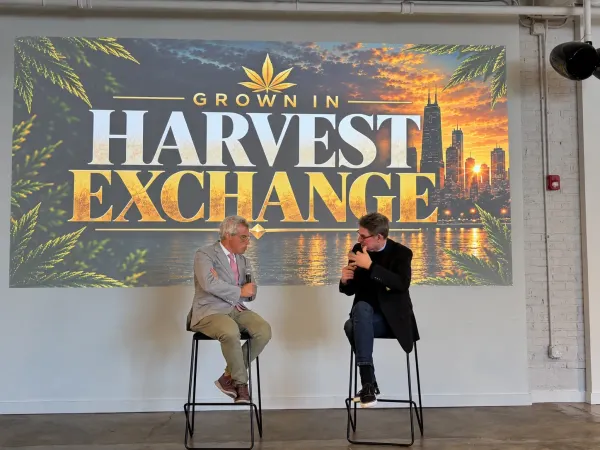
Last week's Grown In Harvest Exchange in Chicago provided a fascinating laboratory for that exercise.
Cannabis entrepreneurs, licensed operators, hemp beverage innovators, researchers, lawmakers, investors, technologists and assorted pranksters gathered to discuss the peculiar realities of building businesses in an industry where something can be simultaneously legal, illegal, medically promising, socially acceptable, politically radioactive and commercially irresistible.
We called our morning exercise Festivus.
What emerged was something more consequential than a collection of grievances. It was a framework for asking who benefits when frontier industries finally get their acts together.
At Project Middle Ground, we intend to institutionalize that question.
Because the consumers are the rest of us.
Two Pathways, One Plant
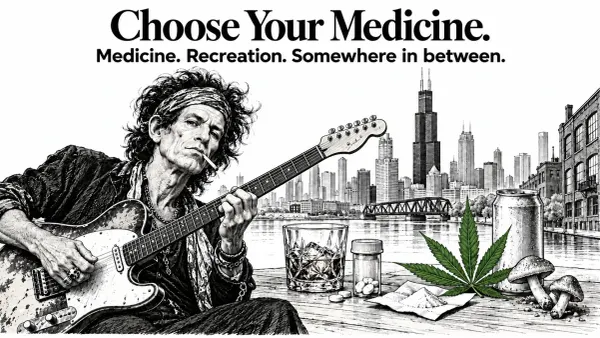
One particularly important insight concerned the necessity of thinking differently about recreational and medical cannabis.
The distinction is not between good cannabis and bad cannabis. It's between two fundamentally different public purposes.
On the recreational side, we should be exploring safe, intelligently regulated pathways for low-dose products to become as ordinary and accessible as other adult consumer goods.
A two-milligram cannabis beverage shouldn't necessarily require the same commercial infrastructure as a high-potency product intended for experienced consumers.
That doesn't mean abandoning safeguards. It means designing them around actual risk, dosage, consumer behavior and public health rather than the political baggage attached to a plant.
Medical cannabis demands a different starting point.
Let's think about healing first.
Before dispensary economics, retail consolidation, branding strategies or investor returns, the central questions ought to concern patients, therapeutic potential, clinical evidence, accessibility and the medical professionals who help people heal.
That's why we were particularly thankful for participation from the Cannabis Research Institute, based at the University of Illinois Chicago and originally incubated through the University of Illinois System's Discovery Partners Institute.
Illinois is making institutional investments in professionalizing cannabis research. That work can connect scientific inquiry, community experience and evidence-based policymaking.
The tea leaves suggest a future in which medical cannabis becomes an increasingly serious subject of federal research and engagement, even as the recreational marketplace navigates its own complicated politics.
Chicago should be preparing to lead that conversation rather than merely reacting to Washington.
November 12: A Punt, Not Necessarily a Funeral
Meanwhile, November 12 is approaching.
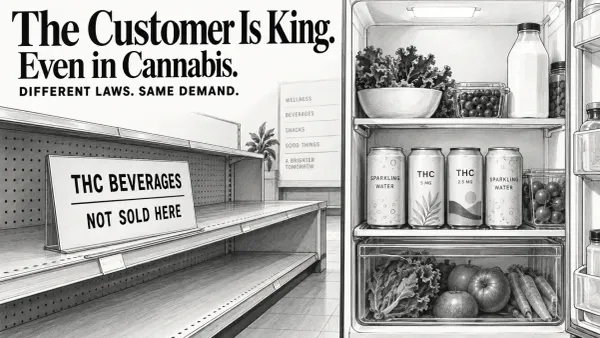
That's when Illinois' new hemp framework takes effect, pushing most intoxicating hemp beverages out of ordinary retail channels and into the licensed cannabis regime.
From the perspective of consumers who have discovered low-dose THC drinks at neighborhood establishments, this is no small disruption.
For retailers and entrepreneurs facing lost revenue, shuttered product lines and difficult decisions, the consequences are real.
But an interesting distinction emerged from the conversations surrounding Festivus.
Among the beverage entrepreneurs and industry participants we encountered, the prevailing posture felt less like existential panic and more like a punt, a reset and an acknowledgment that the regulatory football remains very much in the air.
These are people who knew the risks.
Many are also in the rooms where the next set of rules will be negotiated.
They are watching several jump balls at once: Illinois regulations, federal policy, licensed distribution, the future of hemp-derived cannabinoids and the broader consumer appetite for alcohol alternatives.
A punt isn't surrender. Sometimes it's how you stay in the game.
The more interesting question is whether the next possession produces a better marketplace for consumers.
Hallucinations, Reefer Raconteurs and the Chicago Way
Chicago has another advantage in this emerging conversation.
We are simultaneously positioning ourselves around responsible and applied artificial intelligence, advanced quantum technologies and the increasingly serious science of cannabis.
These are not unrelated ambitions.
All three challenge existing assumptions about what is possible, who gets to participate, who sets the rules and who bears the consequences when institutions move faster than their understanding.
Consider the word hallucination.
In artificial intelligence, it describes the disconcerting tendency of sophisticated systems to generate plausible but false information.
Bring a few Northwestern professors together with cannabis researchers, entrepreneurs and reefer raconteurs, and hallucination becomes an especially entertaining point of departure.
But underneath the wordplay lies a rather serious proposition.
How many of our assumptions about cannabis are themselves hallucinations?
Which are supported by evidence? Which are inherited from generations of prohibition? Which reflect the economic interests of incumbents? And which might be overcome through research, responsible technology and the uncomfortable business of talking with people who disagree?
Responsible AI is not simply about making machines behave.
It's about requiring humans to become more disciplined in distinguishing what we know from what we merely believe.
That's a pretty good framework for cannabis, too.
The People Who Live the Contradictions
Of course, industries are not abstractions.
They are people.
People who navigate Illinois' famously complicated licensed marketplace, build brands, employ workers, raise capital, navigate compliance and still sometimes advocate for allowing cannabis sales outside the very licensed system in which they operate.
Is that hypocrisy?
Perhaps.
Or perhaps it is the unavoidable tension between building a business within existing rules and recognizing that those rules may not represent the best possible future.
Festivus provides permission to acknowledge such contradictions without immediately assigning villains and heroes.
The operator defending a license may also believe the consumer deserves more choices.
The beverage entrepreneur advocating broader distribution may also understand why testing and age restrictions matter.
The lawmaker defending social equity may also recognize that the financial structure of legal cannabis has left too many people behind.
And the researcher may remind everyone that the underlying plant doesn't particularly care how our regulatory categories are arranged.
That's why the Airing of Grievances matters.
Not as performance. Not as therapy. And certainly not as another trade association meeting where everybody agrees that government is the problem.
The purpose is to translate contradictory interests into practical civic intelligence.
Playing in the Band
Today would have been Bob Weir's 79th birthday.
The late Grateful Dead guitarist spent much of his life performing music whose brilliance emerged not from everyone playing the same thing, but from musicians listening, improvising, challenging one another and occasionally finding themselves somewhere none could have reached alone.
In Playing in the Band, Robert Hunter's words, set to music by Weir and Mickey Hart, begin with competing faiths in reason and might.
That tension feels remarkably appropriate for an industry divided between scientific evidence, political power, economic survival and a stubborn conviction that something better remains possible.
Project Middle Ground's Festivus framework is an invitation to keep playing together, even when the music gets strange.
For cannabis, the next movement should be a civic conversation about distinct recreational and medical pathways, intelligent consumer access, rigorous research and a marketplace that works for more people than those fortunate enough to hold licenses.
For AI, it means moving beyond abstract fears toward responsible applications that deliver tangible public benefits.
For quantum, it means treating the common good not as a charitable afterthought, but as a predicate for the sustainable creation of an entirely new industry.
These frontiers will be shaped by entrepreneurs, researchers, investors, politicians and regulators.
But they will ultimately be judged by everyone who has to live with the results.
And the rest of us deserve a seat at the table.
Happy birthday, Bobby.
We're still playing in the band.