Sherwood Forest, Drive-Thru Weed, and the Beverage Question

What we learned from the first Midwest Cannabis Forum
There is a Robin Hood problem in cannabis.
Actually, there are several.
There is Robinhood, the trading platform, where cannabis investors can view certain cannabis-related securities and ETFs, including names like the Roundhill Cannabis ETF and AdvisorShares Pure US Cannabis ETF. The market is visible, but still strange: federally illegal plant, publicly visible tickers, ETFs tracking companies caught between state legality and federal contradiction. Then there is Robin Hood, the anti-poverty nonprofit formerly led by Wes Moore, now governor of Maryland. Moore also previously served on the board of Green Thumb Industries, resigning in 2022 before becoming governor, and later placed nearly $1.2 million in Green Thumb stock into a blind trust. And then there is the older story hiding behind the name: Sherwood Forest.
The outlaw in the woods. The redistribution myth. The idea that something taken by power might be returned through a different kind of public legitimacy.
Cannabis has been living inside that story for a long time.
For decades, the plant was illegal but everywhere. Punished but profitable. Cultural but criminalized. Ordinary in use, extraordinary in consequence. Then legalization arrived and promised, in Illinois especially, not just a market but repair.
Expungement. Social equity. Reinvestment. Licenses. Ownership. Opportunity.
A legal path out of the forest.
But markets have a way of complicating myths.
Now cannabis is not only asking who gets a license. It is asking who gets distribution. Who gets shelf space. Who gets banking. Who gets data. Who gets research. Who gets to sell a beverage at a concert. Who gets to offer curbside pickup or drive-thru convenience. Who gets to define “safe,” “legal,” “intoxicating,” “responsible,” and “fair.”
Fair, of course, is where the whole conversation starts wobbling.
Who says fair?
Licensed operators say fairness means recognizing the capital, compliance, security, testing, municipal approvals, taxes, labor, and regulatory weight they accepted to build state-licensed cannabis channels.
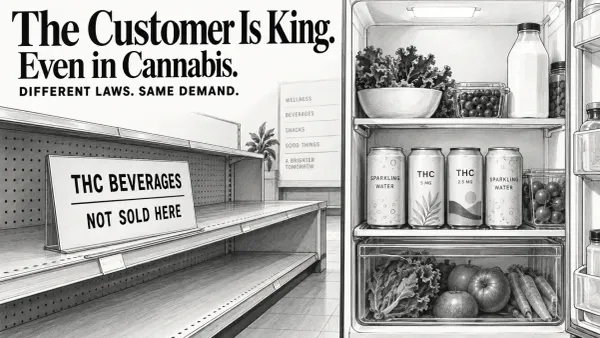
Hemp beverage entrepreneurs say fairness means recognizing consumer demand, legal ambiguity, innovation, alcohol alternatives, and the simple fact that people do not always want to walk into a dispensary to buy a low-dose drink.
Public health voices say fairness means protecting consumers from confusing labels, intoxicating products sold through casual retail, youth access, and inconsistent oversight.
Social-equity entrepreneurs say fairness means remembering why legalization was framed as repair in the first place — and asking whether the people harmed by prohibition are actually gaining ownership, capital access, and durable advantage.
Consumers, meanwhile, tend to ask a more Chicago question:
Can I get what I want, safely, without making it weird?
That may be the most important market signal of all.
Because cannabis is increasingly becoming a convenience category.
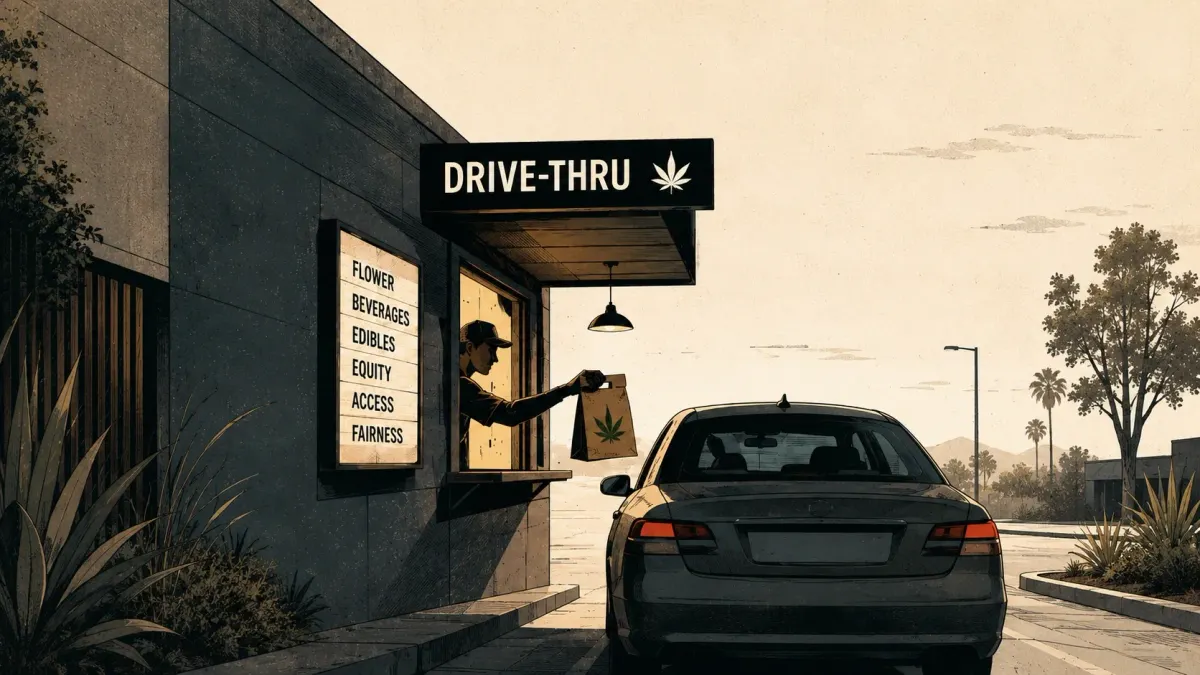
Illinois already allows state-licensed adult-use cannabis sales under a controlled program administered by IDFPR. Medical curbside pickup has been permanently authorized, and dispensaries increasingly compete on online ordering, pickup, and smoother retail flow. So yes, the phrase almost writes itself:
Billions and billions of buds served.
But that is not just a joke. It is a systems question.
If cannabis goes more drive-thru, more curbside, more click-and-collect, more beverage-menu, more venue-friendly, more hospitality-adjacent, then the industry moves from novelty to infrastructure.
That is what happened with coffee.
That is what happened with beer.
That is what happened with fast casual.
That is what happens when a category stops being a special trip and becomes an ordinary occasion.
The next question is obvious:
What drink goes with the flower?
Not too strong. But how strong?
Under what regulatory regime?
With what label?
Sold by whom?
Taxed how?
Served where?
At the United Center? At a bar? At a liquor store? At a licensed dispensary? At a music venue? At a backyard industry forum at Salvage One where half the room is talking about normalization while the other half is trying to figure out where the rules will land?
That was the live experiment.
The first Midwest Cannabis Forum was not just a conference. It was mixed-media messaging in physical form: licensed cannabis operators, hemp beverage people, bankers, lawyers, workforce voices, researchers, sponsors, flower, playlists, policy questions, and the unavoidable sense that the market has entered its “yes, but under whose rules?” phase.
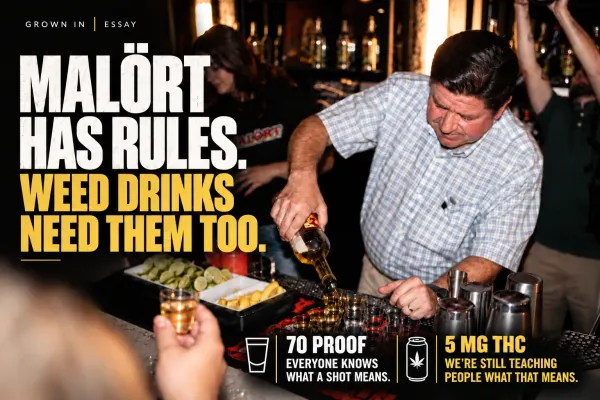
Chicago is already part of the beverage test. The United Center has begun offering THC-infused beverages at select special events, sourced from hemp-derived cannabis and sold under brands including Rythm and Señorita.
At the same time, Chicago has been wrestling with how to regulate intoxicating hemp. City Council voted to ban most intoxicating hemp products while exempting beverages, topical creams, and pet products, before Mayor Brandon Johnson vetoed the ordinance and called for a more balanced regulatory approach. That is not a side story.
That is the story.
The category is splitting in real time.
One molecule, two markets.
On one track: state-licensed cannabis, regulated heavily, taxed heavily, built slowly, guarded by compliance, expensive to enter, and still federally constrained.
On another track: hemp-derived intoxicants and beverages, federally enabled by the 2018 Farm Bill, commercially nimble, culturally accessible, and now facing waves of local, state, and federal attempts to narrow, regulate, or close the loophole.
That is where the Midwest matters.
The Midwest is not just a place cannabis gets sold. It is where cannabis can become legible.
Chicago is a venue town. A beverage town. A logistics town. A finance town. A neighborhood town. A real estate town. A hospitality town. A city where the question is rarely “Can this be cool?” and more often “Can this be run?”
That is why intoxicating hemp beverages at places like the United Center matter.
That is why Up-Down and other social venues matter if they are testing or selling THC beverages.
That is why Señorita matters.
That is why Rythm matters.
That is why drive-thru cannabis matters.
That is why Baird & Warner Chicago showing up around Grown In does not feel random.
Home, place, neighborhood trust, hospitality, and the built environment are not outside the cannabis story anymore. They are part of normalization. We thank Marcy Alspach for understanding that instinctively — and for the Flower Bar, which turned the Midwest Cannabis Forum into something warmer than a policy room and more elegant than a trade show.
That matters because cannabis is overburdened with bad rooms.
Rooms that feel too transactional.
Rooms that feel too defensive.
Rooms that feel like everyone is waiting for the other shoe, the next lawsuit, the next rule change, the next tax problem, the next federal delay.
The Midwest Cannabis Forum was an attempt to build a better room.
Not a perfect room.
A better one.
What did we learn?
First, rescheduling is a signal, not the system. Moving cannabis toward Schedule III would acknowledge medical value, open research pathways, and likely remove the 280E tax burden that has punished licensed operators. But it will not automatically fix banking, interstate commerce, social equity, hemp confusion, state fragmentation, or consumer education.
Second, euphoria is not necessarily a toxic side effect.
That sentence sounds simple, but it may be one of the cultural keys to the next decade. For too long, cannabis policy has struggled to talk honestly about why people use the plant. Medical language can make cannabis legible to institutions. Wellness language can make it legible to consumers. But pleasure, relief, sociability, creativity, appetite, laughter, music, sleep, and ordinary mood improvement are not policy bugs. They are part of the product reality.
The question is not whether people want to feel something.
Of course they do.
The question is whether the market can help people feel something with clarity, moderation, safety, and trust.
Third, the plant is not as simple — or as scary — as the old categories made it sound. Cannabis is not harmless. Nothing embodied is harmless. Alcohol is not harmless. Sugar is not harmless. Gambling is not harmless. Solitude is not harmless. Bad policy is not harmless.
But “not harmless” is not the same as “must remain culturally exiled.”
Normalcy does not mean pretending risk disappears.
Normalcy means building adult systems around real behavior.
Fourth, commercial repair cannot be allowed to become a slogan.
Illinois’ social-equity program was one of the boldest attempts in the country to attach legalization to justice. It also became a case study in how hard it is to translate moral architecture into licenses, capital, operations, real estate, banking, and actual ownership.
That context cannot be rehashed forever, but it also cannot be skipped.
Especially not as Governor J.B. Pritzker’s national profile rises.
Pritzker’s cannabis legacy is part of his larger governing argument: Illinois as a state willing to turn frontier categories into systems. Cannabis legalization. Social equity. Research infrastructure. Quantum investment. South Side industrial ambition. The “application city” thesis with a Springfield engine behind it.
If he marches toward Washington, cannabis comes with him.
Not as a fringe issue.
As evidence.
Evidence that future-facing policy is not just about labs and chips and quantum machines. It is also about repair, markets, stigma, regulation, consumer behavior, and the question of who gets to own the next economy.
That is where Sherwood Forest comes back.
Cannabis is full of outlaws trying to become operators, operators trying to become institutions, institutions trying to become trusted, and communities trying to see whether the legal market will return anything meaningful from what prohibition took.
Robinhood can show you a cannabis ETF.
Robin Hood can remind you that capital and poverty have always occupied the same American story.
Green Thumb can remind you that the industry’s most powerful companies often sit at the intersection of public markets, political networks, retail scale, and social-justice language.
And Sherwood Forest can remind you that legitimacy is never only about who holds the bow.
It is about who the story says the forest belongs to.
The Midwest Cannabis Forum did not answer all of this.
Good.
The point was not to finish the argument.
The point was to publish the room where the argument could mature.
Because cannabis is entering its next chapter.
Drive-thru convenience.
Venue beverages.
Federal rescheduling.
Hemp regulation.
FDA research.
Social-equity repair.
Consumer normalcy.
Institutional money.
Neighborhood trust.
Flower bars.
Baird & Warner Chicago.
Señorita at the United Center.
Up-Down, maybe, and the next wave of places where cannabis culture becomes ordinary social architecture.
Billions and billions of buds served, perhaps.
But the better question is:
Served through what system?
To whose benefit?
With whose rules?
With whose repair?
With whose trust?
That is the work now.
Not legalization.
Legibility.
Not hype.
Hospitality.
Not only access.
Accountability.
The forest is still there.
But the market has moved indoors.
And the room, if we build it right, can become a clearing.