Mindful Networking in a Frontier Sector

Why cannabis is becoming more like Chicago itself: associative, cross-pollinated, regulated, commercial, civic, and very much alive
There comes a moment in every frontier industry when the room changes.
At first, the room is full of true believers, opportunists, scavengers, wounded idealists, hustlers, policy nerds, and people who think they can smell the future before the rest of the mammals. Cannabis has had that room for years. It still does. But lately the room is changing. Or maybe more precisely, the doors around the room are opening.
Commercial cannabis is converging with the broader economy in ways that no longer feel theoretical. Hemp beverages are showing up in iconic institutions and national distribution channels. Banks, while still waiting for Washington to stop sleepwalking around SAFE banking and the broader regulatory mess, are no longer pretending this sector is beneath notice. Researchers in medicine and agriculture are getting more resources, more legitimacy, and more reason to collaborate. Food ingredients are creeping into the conversation. So are digital startups, compliance platforms, data tools, and the increasingly serious question of what Cannabis 3.0 looks like when the novelty burns off and infrastructure finally becomes the story.
That is where mindful networking comes in.
Not networking as a stack of business cards or a hall of dead-eyed badge scans. Networking as infrastructure. Networking as cultivation. Networking as the self-selecting process by which a serious ecosystem decides what kind of market it wants to live in and, eventually, pass it on with some dignity to the poor souls who show up after the first wave of maniacs has done all the improvising.
Cannabis is not entirely different from the other frontier sectors circling Chicago and the Midwest right now. Climate energy. Quantum. Responsible AI. Different technical substrates, same social challenge: how do you create a critical mass of people who can build a market without turning it into a caricature of itself? How do you take a sector that begins in code words, stigma, edge cases, and regulatory confusion and turn it into something that can coexist with logistics, consulting, finance, life sciences, food, CPG, and public life without losing its pulse?
Chicago, to its great credit and occasional absurdity, is built for this.
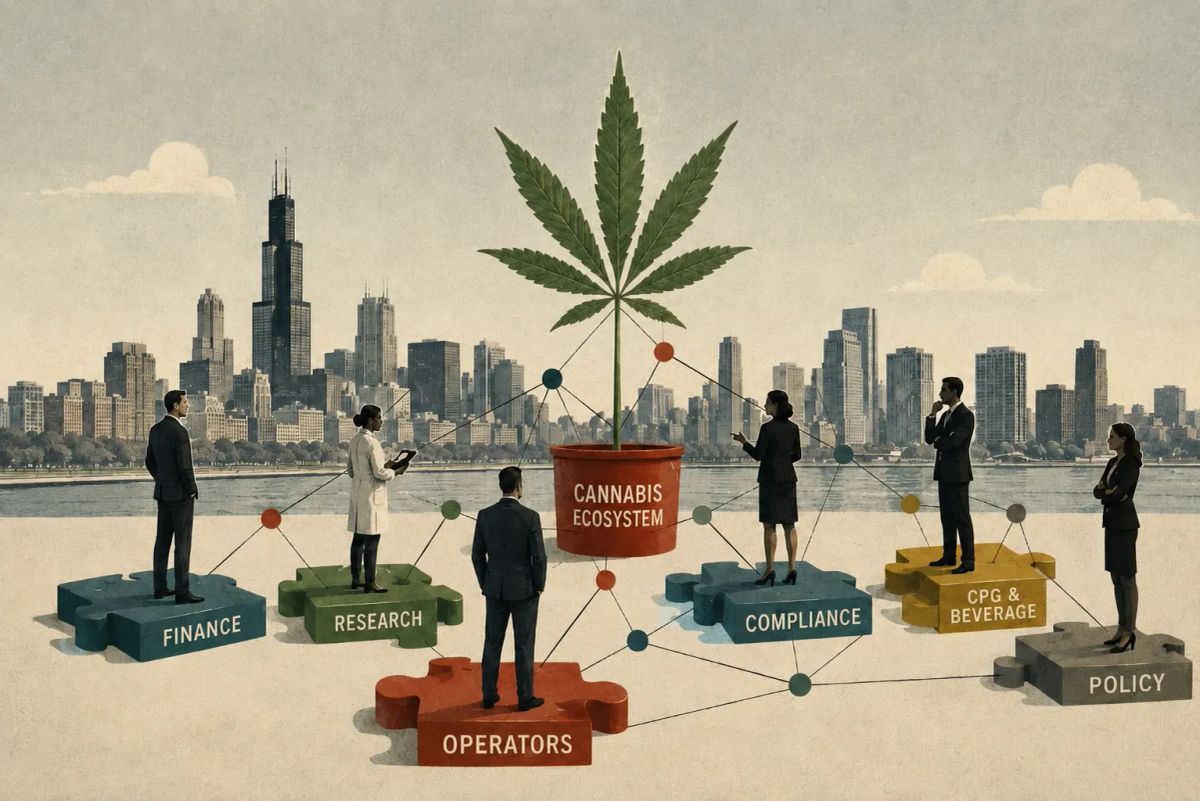
This is an association town. Maybe second only to Washington, depending on the season and the bar tab. Chicago is where industries come to hold meetings about their own existence. It is a city wired for trade groups, conferences, conventions, operating committees, side dinners, boardrooms, and accidental coalitions. That can be tedious. It can also be a superpower. Because when you have logistics, food, finance, law, life sciences, branding, advanced manufacturing, and institutional muscle all living in one metro with the same weather and traffic problems, cross-pollination stops being a metaphor and becomes a business model.
That matters for cannabis now.
For years the sector talked mostly to itself. Operators talked to operators. Regulators talked to regulators. Investors talked to themselves, which is not always the same thing as talking. Everyone had a lane, and the lanes were narrow enough to preserve grievance as a form of identity. But mature industries don’t actually work that way. Mature industries are built by collisions — quantitative and serendipitous, formal and accidental, spreadsheet-driven and grill-side. The person from banking shares notes with the person from beverage. The compliance expert talks to the agricultural researcher. The CPG strategist hears something from the lab operator. The M&A lawyer starts noticing patterns across licensed entities in Illinois, Michigan, Missouri, Ohio. Somebody from food ingredients realizes cannabis has a formulation problem that looks suspiciously like another category’s solved problem in different pants.
That is networking, too. Mindful networking. Frontier networking.
Not who can I impress, but what do I need to understand? Not how do I look important, but what pattern is emerging between people who don’t normally share a room? The old business cliché says your network is your net worth. Fair enough. But in cannabis, especially now, your network is increasingly your regulatory intelligence, your distribution hypothesis, your hiring strategy, your early warning system, and your chance at not becoming obsolete while still telling yourself you’re early.
This is especially true as 40-plus states continue building the weed business through a messy patchwork of laboratory experiments. Some states are deep on regulation and shallow on commercial creativity. Others are the opposite. Some have natural infrastructure for growth. Others have political will but clumsy implementation. Some have produced meaningful standards. Others have produced PowerPoint decks disguised as governance. Over time, national frameworks won’t arrive by magic. They’ll emerge by synthesis: best outcomes, worst mistakes, patterns that can survive contact with multiple states, multiple regulators, multiple business models, and multiple forms of public tolerance. That synthesis is not just a policy exercise. It is a relationship exercise.
And now comes hemp.
Schedule 3 remains unresolved enough to keep lobbyists employed and operators mildly ulcerated. The Farm Bill remains the great American loophole generator and cleanup project. Meanwhile, hemp beverages and related products are moving through national distribution in ways that would have sounded like fan fiction a decade ago. This is where the old guard of cannabis and the newer entrants into the category are going to have to decide whether they want to build a sector or just win arguments on the internet. Because national beverage distribution, unlike dispensary tribalism, requires actual institutional fluency. Retail. Compliance. Packaging. Ingredients. Logistics. Age-gating. Consumer education. Hospitality. Channel strategy. The stuff that sounds boring right up until it mints the next billion-dollar winners.
Holy Toledo.
And here comes summer to make the point even less avoidable. Grilling season. Lake season. Patio season. Ballgame season. Midwestern civilization in its sleeveless best. People are drinking less alcohol. They are increasingly drinking weed, or smoking it, or ingesting it in formats that feel less like rebellion and more like category management. Who’s kidding who? America is running a giant social experiment around altered states either way. One can still ask, impolitely but honestly: what makes people stupider when over-consumed, weed or wine? Which one feels worse the next morning? Which one makes a Tuesday night at the lake feel more like a soft exhale than a chemical hostage situation? Brave New World, yes, but also extremely practical Midwest consumer behavior.
The baseball analogy helps here.
Look around the Midwest: Chicago, Milwaukee, St. Louis, Detroit. Storied franchises, imperfect ownership structures, fan bases that understand suffering as a civic dialect. Baseball works because it creates a national pastime out of local repetition. Different teams, different payrolls, different histories, same larger structure. A self-selecting crew of players, managers, operators, sponsors, broadcasters, vendors, and believers creates an infrastructure durable enough to be inherited. That is not a bad metaphor for where cannabis is heading. Not because weed is baseball, although one can easily imagine the first stadiums to embrace hemp beverages eventually becoming case studies in institutional courage or opportunism, depending on how the press release is written. But because both industries depend on a critical mass of professionals colliding in public and private, season after season, until the whole thing starts to feel inevitable.
Chicago should be one of the cities where that inevitability gets organized.
Not just because Illinois moved early on legal cannabis. Not just because this region knows logistics, food, finance, and regulated markets. But because Chicago has the weird old civic habit of convening sectors that don’t fully understand yet why they need one another.
That is where the next phase of cannabis gets built.
Through mindful networking. Through grown-up collisions. Through a city and a region deciding that cannabis is not merely a product category or a political football, but one of several frontier sectors that will reward the people patient enough to build the infrastructure they themselves would want to inherit.
We ain’t wasting time no more.