Rescheduling Is the Signal. Not the System.
The next decade won’t belong to the loudest weed market. It will belong to the city that knows how to turn chaos into an industry.

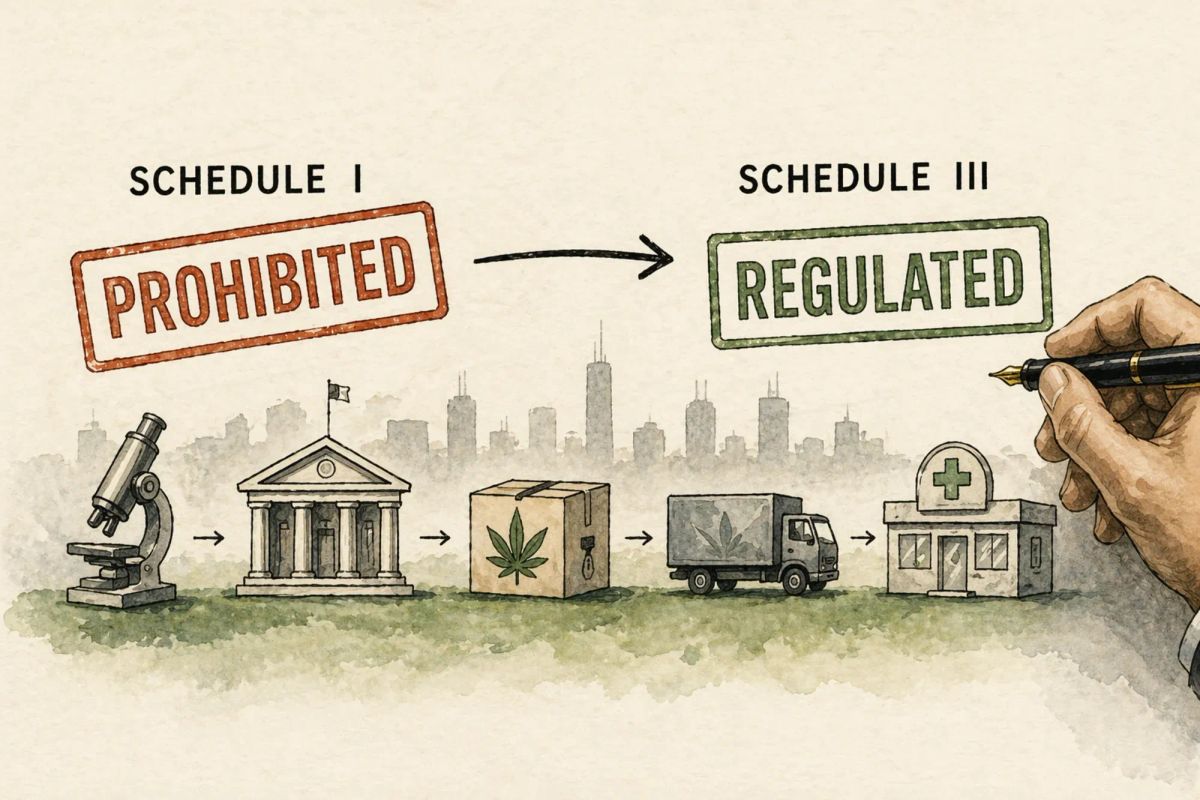
The Justice Department’s move to place FDA-approved marijuana products and marijuana products subject to a qualifying state medical license into Schedule III is not the end of the cannabis story. It is the end of one tone of voice. Cannabis is moving — awkwardly, politically, incompletely, but unmistakably — out of permanent exception status and into the slower, more consequential machinery of institutional legitimacy.
That does not mean weed goes corporate overnight. It means the industry starts getting judged the way serious industries get judged.
Not by vibes. Not by outlaw glamour. Not by who can still talk like it is 2018.
By product quality. By research depth. By banking access. By logistics. By insurance. By compliance. By trust. By category clarity. By the ability to explain what this thing is becoming to consumers, regulators, investors, doctors, manufacturers, hospitality groups, and ordinary adults who no longer want every cannabis conversation to sound like either a dorm room or a deposition.
That is the next decade.
And it is why Chicago should stop acting like cannabis is somebody else’s cultural property and start acting like it is our kind of systems problem.
Because that is what Chicago has always known how to do.
This city does not always invent the sexiest mythology. California will keep that. New York will keep the media reflex and the financial theater. Miami will continue doing what Miami does, which is to make almost everything look like bottle service with a cap table. Fine. Let them.
Chicago’s superpower is different. Chicago is America’s great applications town. It knows how to take complicated, regulated, logistics-heavy, capital-sensitive industries and make them legible, governable, financeable, and real.
That is exactly what cannabis is becoming.
The first era of cannabis was frontier capitalism with better branding. Plenty of money, plenty of improvisation, plenty of talk about disruption, social change, access, justice, liberation, lifestyle, medicine, and culture — often all in the same paragraph, and often without enough adults in the room to distinguish one from the other.
The next era will be less forgiving.
Medical cannabis, for one, is headed toward a more serious future. The federal shift should make it easier to imagine deeper research, stronger institutional participation, and a more credible evidence base around products, delivery methods, and use cases. Over time, the strongest players may look less like traditional dispensary operators and more like hybrid businesses spanning formulation, data, clinical insight, patient education, and regulated product development.
That is not a side story. That is one of the main stories.
Another is banking.
For years, cannabis banking has functioned like a dare. Which bank will touch it? Which lender will tolerate it? Which payment platform will risk the friction? Over the next decade, the novelty should fade and the infrastructure question will take over. The issue will no longer be who is bold enough to enter the market. It will be who is competent enough to serve it.
Again: Chicago.
This city knows treasury. It knows middle-market finance. It knows payments. It knows B2B infrastructure. It knows how legal complexity, insurance, underwriting, compliance, and reputation all sit beneath growth whether founders want to talk about those things or not.
And insurance, by the way, is not a side note. Neither are accounting, tax, HR, cybersecurity, construction, risk management, public affairs, crisis communications, testing, transportation, and every other allegedly boring service that shows up the moment an industry stops being cosplay and starts becoming permanent.
That is one of the least romantic truths about normalization: before a sector feels settled, it starts hiring a civilization.
Cannabis is getting there.
So is culture.
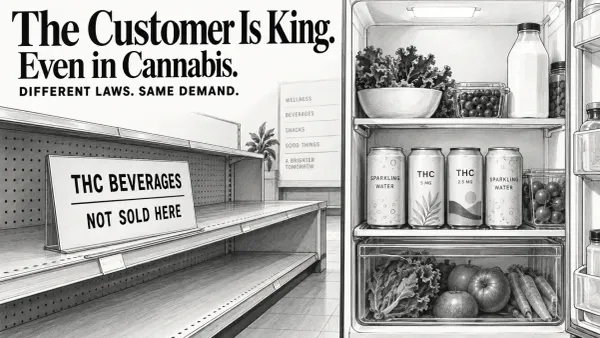
The most important shift in consumer culture is not that cannabis will replace alcohol. It won’t, at least not in the cartoonish way some of the industry’s more self-flattering evangelists once hoped. Alcohol is not going to disappear because low-dose beverages got smarter. But alcohol will lose certainty. And that matters.
Cannabis will increasingly compete in specific occasions: the second drink, the wellness-aware social night, the premium hospitality moment, the weekday unwind, the “I want to feel something but still be useful tomorrow” choice. It will not wipe out the bar cart. It will complicate it.
That complication will spread into CPG.
Beverages will deepen. Beauty and personal care will deepen. Sleep and recovery will deepen. Functional confections will deepen. Intimate wellness will deepen. Culinary formats will deepen. Over time, more pharmacy-adjacent categories will move closer too, especially if research and regulation keep hardening into something adults in lab coats and adults in finance both recognize as durable. The plant will remain the plant. The categories around it will proliferate.
And here the old cannabis aesthetic starts to lose its monopoly.
The industry’s next decade will be shaped less by stale male-coded frontier posturing and more by tone, trust, ritual, product intelligence, and human-scale design. Women are already driving some of the smartest shifts in format, consumption style, and category imagination. The future looks less like rebellion as costume and more like lived integration. Less chest-thumping. More fit. More nuance. More actual adulthood.
This is not the softening of cannabis.
It is the growing up of cannabis.
Which brings us back to Chicago.
Chicago knows how to host complicated sectors without asking them to become simplistic stories first. It knows food and beverage. It knows manufacturing. It knows healthcare. It knows law. It knows insurance. It knows logistics. It knows banking. It knows how to move goods, structure risk, and convene unlike institutions in the same room long enough for a useful sentence to emerge.
That last point matters most.
Because the next decade of cannabis will belong to the places that can coordinate between operators, regulators, scientists, investors, consumer brands, professional service firms, and public officials without reducing the conversation to either panic or boosterism. It will belong to the places that can turn a messy category into durable civic and commercial infrastructure.
That is Midwest work.
Not flashy, maybe. Not coastal enough for some tastes. Not drenched in enough self-mythology for others.
But real.
And reality is where industries either mature or break.
The old frontier phase of cannabis needed pioneers, cowboys, evangelists, and survivors. The next phase needs translators, builders, category managers, bankers, insurers, researchers, governors, logistics people, compliance adults, and the kinds of operators who understand that once an industry enters institutional legitimacy, the back office is no longer the back office. It is the future.
Chicago should want that job.
Not because it is humble. Because it is powerful.
If the federal government is finally nudging cannabis out of the bunker and into the slow architecture of public legitimacy, then the biggest long-term winners may not be the loudest lifestyle markets. They may be the regions that know how to professionalize, coordinate, govern, insure, finance, and explain the category as it grows up.
Chicago has been training for that role its whole life.
The plant may still be the headline.
But the Midwest should own the operating system.