Chicago Cannabis Is Entering Its Session Beer Era

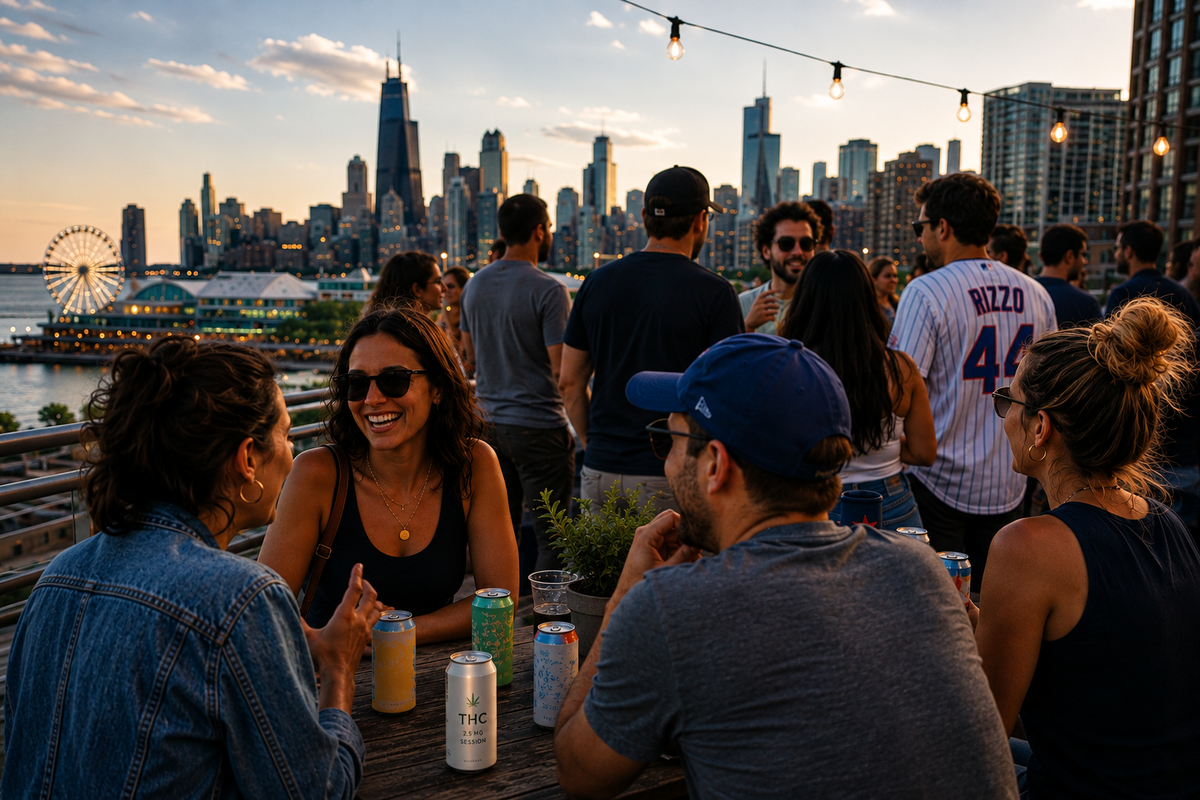
Where Chicago gathers, a new ritual begins
Chicago cannabis may finally be entering its session beer era.
Not through smoke shops. Not through dispensary flower wars. Not through another round of tax debates, moral panic, or political press conferences with the usual stiff collars and softer questions. It may arrive through something more powerful in this city than almost anything else:
Venue infrastructure.
That may sound dry until you remember what Chicago really is. This is a sports town, a festival town, a summer-evening-on-the-lakefront town. It is a city that knows how to gather. Bears Sundays. Cubs afternoons. Bulls mythology. Blackhawks ghosts. Concert lines. Pier crowds. Rooftops. Beer gardens. The concourse. The patio. The stretch of civic life where people don’t want a sermon or a policy memo. They want to be with other people, have something in their hand, and feel normal.
That is why the reported consolidation of THC beverage distribution rights at Navy Pier under the orbit of the Kovler family’s expanding influence, following earlier positioning around United Center beverage access, matters as more than another market-share story. It suggests that some of Chicago’s most institutionally connected cannabis players understand that the next phase of normalization may not look like cannabis at all.
It may look like hospitality.
For years, cannabis in Illinois has often felt trapped between two costumes. On one side was the dispensary era, all glass counters, tight regulations, and flower wars that too often reduced the future of the category to discount menus and margin pressure. On the other side was the old culture-war frame, where cannabis still had to carry the burden of being either a vice, a cause, or a symbol. Neither lane was built for broad, everyday adoption.
Beverages change the frame.
Low-dose THC drinks do not ask to be treated like a joint. They do not announce themselves with the same ritual, the same stigma, or the same sense of separation from ordinary social life. They arrive in a can. They can be poured over ice. They can sit in a cooler. They can live next to a light beer, a canned cocktail, or a sparkling water and not look like a revolutionary act. In a city like Chicago, that matters. This is not merely a product shift. It is a behavioral shift.
Cannabis, in other words, may be moving from protest object to occasion object.
That is a big deal.
It is also why venue control matters so much. If you want to understand the next phase of normalization, stop thinking only about dispensaries and start thinking about where the city teaches people how to behave. Stadiums do that. Piers do that. Concert venues do that. Festivals do that. The hospitality layer is not some side story. It is the story.
Ben Kovler has long understood that cannabis was never only about weed. It was about systems. Distribution. Legitimacy. Public behavior. Consumer habit. The larger point of a venue town remains key here. Chicago does not merely consume products. It absorbs rituals. Once something becomes legible inside the places where Chicago gathers, it ceases to feel fringe. It begins to feel civic.
That may be the real frontier.
The old joke in this town is that Chicago can make anything into a religion if you put enough parking around it, sell enough merch, and let it breathe through enough Sundays. Bears fandom taught us that. So did Jordan-era basketball. So did summer on Waveland, or the strange sacrament of standing shoulder to shoulder with strangers in a city that knows how to turn public space into memory. That same civic machinery may now be getting pointed, slowly and almost politely, toward cannabis beverages.
This is where the “session beer” analogy matters.
For decades, alcohol culture in America had a lane for intensity and a lane for sociability. The latter is where session beer lived. Not the drink of oblivion. The drink of staying in the game. The drink that could accompany a conversation, a ballgame, a long afternoon, a second act. If Chicago cannabis is entering that kind of era, it means the category is being redefined less by maximum potency and more by context. Lower-dose. Social. Managed. More beer garden than basement. More hospitality than head shop.
That does not mean the old cannabis economy disappears. Flower remains. Dispensaries remain. Tax debates remain. Lawsuits remain. The highly Chicago collision of ambition, regulation, and grievance remains. But the center of gravity may start shifting toward formats that are easier for institutions to host and easier for consumers to integrate into public life.
That is why this is not merely a GTI story or a Kovler story, though it is certainly both. It is a Chicago story.
It is a story about a city that has always excelled at applications. Chicago is not Silicon Valley. It is not Hollywood. It is not a city that wins by floating above the real economy in a cloud of self-mythology. It wins by operationalizing things. By building systems around them. By figuring out how trains, finance, food, law, manufacturing, media, and civic life can all grind against one another until something useful emerges.
That is true in quantum, too, which is part of why the broader civic metaphor still holds. Quantum only matters if it escapes abstraction and enters systems. Cannabis is not so different. The next phase is not just about the molecule. It is about the infrastructure around the molecule. Who distributes it. Who sanctions it. Who places it in contexts that people already trust. Who turns novelty into ritual.
That is what venue power can do.
And that may be the real signal coming out of Navy Pier and the United Center. Not simply that THC beverages are available in high-profile places, but that Chicago’s most connected cannabis players increasingly understand the future of the industry will be shaped in places where people gather, mingle, celebrate, and exhale. Not necessarily to get high. Not even necessarily to make a statement. Just to participate in a new form of normal.
That is how categories grow up in this city.
Quietly at first. Then everywhere all at once.
Not by demanding to be understood, but by becoming harder and harder to avoid.
Chicago cannabis may finally be entering its session beer era.
And if that is true, the next battle will not be fought only in the dispensary, the legislature, or the courtroom.
It will be fought at the bar.