Now the Die Is Shaken. Now the Die Must Fall.

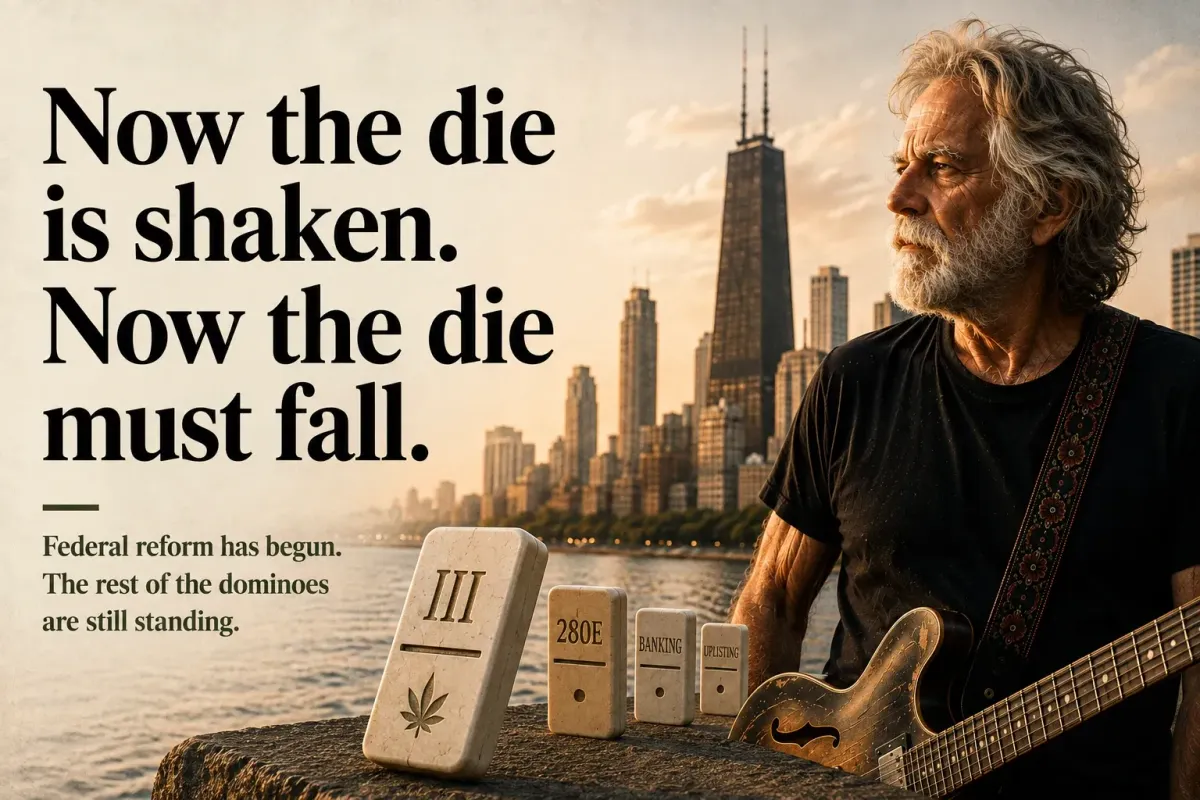
Four Chicago-connected cannabis CEOs see federal dominoes falling. Investors have heard this song before. Consumers barely know the band is playing.
Ben Kovler gave investors his version of Jack Straw this week:
“We built the company to stand on its own without waiting for federal reform.… The first domino has fallen.”
The Green Thumb Industries founder was referring to the federal government’s move placing state-licensed medical cannabis—not the entire adult-use industry—into Schedule III of the Controlled Substances Act.
That distinction matters. Medical cannabis has crossed an important federal boundary and can begin receiving relief from the punishing 280E tax rules. Adult-use cannabis remains in Schedule I while the broader rescheduling process continues.
So the first domino has indeed fallen.
It just landed on one side of a legal line that most consumers did not know existed.
The Chicago chorus
Kovler is hardly singing alone.
Curaleaf CEO Boris Jordan told investors:
“Our U.S. business has clearly regained momentum.”
Cresco Labs CEO Charlie Bachtell declared:
“Rescheduling is the first true federal reform this industry has achieved.”
And Verano CEO George Archos observed that a “chorus” of prominent government and business leaders is advocating for banking legislation, rescheduling, exchange listings and broader capital-market access.
The lyrics vary. The chorus is remarkably consistent:
Reform may finally be real. The companies survived. Their balance sheets are improving. Their shares should someday trade where normal American companies trade. Please remain on the line.
There are numbers behind the renewed confidence.
Green Thumb reported $307 million in quarterly revenue and $84 million in normalized EBITDA. Curaleaf produced $340 million in revenue and $70 million in adjusted EBITDA. Cresco reported $173 million in revenue and approximately $40 million in adjusted EBITDA. Verano generated $218 million in revenue and $51 million in adjusted EBITDA.
None of those non-GAAP measurements is perfectly interchangeable, but they describe four publicly traded companies that are still here—and in several cases growing again—after a long descent on the reefer roller coaster.
They are also four Chicago-connected companies led by four white men who, for better or worse, remain among the voices capital markets are most likely to hear when the legal industry speaks.
That is not the whole cannabis industry.
It is the part currently holding the earnings call.
Two launchpads
Green Thumb remains out ahead of this particular pack from a cash and operating-profitability perspective.
Like the Americans in Contact, Kovler has effectively constructed two launchpads.
One operates inside the hedges of state-regulated cannabis: dispensaries, flower, vapes, edibles and Dogwalkers pre-rolls.
The second uses the intoxicating-hemp opening to move THC into ordinary American consumer settings through 12-ounce beverages—the kind recently sold at Lollapalooza, far beyond the velvet ropes and multiple identification checks of a dispensary.
It is a greenprint for mainstream consumption.
One path asks consumers to visit a highly compliant, often somewhat clinical dispensary.
The other puts a five-milligram margarita beside beer, wine and sparkling water at a music festival, arena or neighborhood store.
Same intoxicating molecule.
Different plant classification, tax system, sales channel, regulatory burden and customer experience.
You almost need a cannabis media company to translate it.
Fortunately, here we are.
Curaleaf wants the globe
Curaleaf is technically headquartered outside Chicago, but its acquisition of Chicago-built Grassroots—originally announced at $875 million—brought considerable local talent, intellectual property and institutional history into what became one of the world’s largest cannabis operators.
Jordan recently told a Chicago cannabis-capital audience that institutional investors are again willing to have conversations with cannabis companies. Talking is not investing, but after years outside the velvet rope of conventional finance, even a returned phone call can resemble normalization.
Curaleaf also brought some Studio 54 energy to Chicago’s summer technology calendar with the launch of its BRIQ 2 vape.
No, it does not appear to be a Fitbit for your inhalation habits.
It is a technology-forward cannabis product designed around more consistent dosing, flavor and fewer clogs—which still qualifies as meaningful innovation for anyone who has spent 15 minutes trying to resuscitate an expensive disposable vape.
I’ll have what he’s having.
Cue Katz’s Delicatessen and a love letter to Rob Reiner.
Sorry, Charlie—and thank you
Cresco Labs remains the Chicago stalwart.
Its Sunnyside location near Wrigley operates less like a head shop and more like a highly compliant neighborhood shopping center—an example of what regulated cannabis retail looks like when a company has survived long enough to standardize virtually everything.
Bachtell’s commitment to civic and commercial communication also helped keep Grown In alive during stretches when the economics of independent cannabis media made the economics of cannabis cultivation look straightforward by comparison.
Thank you.
And, as the tuna people taught us, sorry, Charlie.
Cresco reported quarterly net income of $15 million and said Schedule III relief strengthens net income and balance sheets while creating a pathway toward U.S. exchange listings and wider capital access.
The Greek chorus
Leave it to George Archos to identify the chorus.
Verano sees several pieces moving simultaneously:
Federal medical rescheduling. Possible broader Schedule III treatment. Banking legislation. U.S. exchange access. New institutional investors. And the planned federal closure of the intoxicating-hemp loophole on November 12.
Verano, which stayed out of intoxicating hemp, believes closing that channel could move consumers into licensed dispensaries carrying tested, regulated products. The company pointed to stronger regulated cannabis sales in Ohio after that state restricted intoxicating hemp.
It is not difficult to understand why the licensed operators favor that outcome.
They have spent years submitting to security requirements, testing systems, seed-to-sale tracking, packaging restrictions, local zoning, tax penalties and a level of bureaucratic attention normally reserved for nuclear material and Chicago patio permits.
The hemp beverage companies entered through another door.
Some are now asking lawmakers to leave that door open.
Job, now with a Canadian brokerage account
The publicly traded U.S. cannabis investor has spent several years playing the biblical Job—except Job did not have to navigate Canadian primary listings, U.S. over-the-counter trading and quarterly explanations of Section 280E.
Despite operating largely in the United States, these companies still rely on Canadian exchanges or Canadian market infrastructure for their principal listings while seeking eventual access to the NYSE or Nasdaq.
Those investors—and you know that I know that you know who you are—are exhausted, perplexed, defiant and occasionally regretful.
They have listened to years of:
- Reform is coming.
- Banking is possible.
- Uplisting is around the corner.
- Germany is opening.
- Florida is voting.
- The next administration understands us.
- The next Congress understands us.
- The next domino is definitely less structurally attached to the table.
This time may actually be different.
Medical Schedule III is not merely a press release. It creates tangible tax implications for qualifying medical operations. Broader proceedings have also moved forward, although adult-use cannabis remains federally prohibited and the reform trajectory still faces regulatory and legal uncertainty.
The die has been shaken.
Investors would still like to see it fall.
Meanwhile, the consumer has moved on
The corporate conversation is about 280E, DEA registrations, institutional capital and exchange listings.
The consumer conversation is:
Can I buy this drink at the concert?
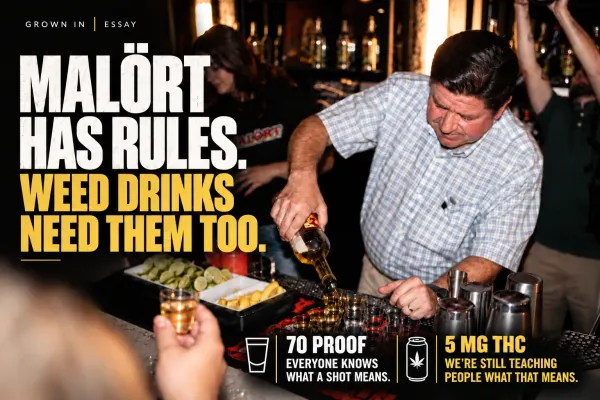
Will five milligrams make me feel anything?
Is 50 milligrams five servings or one exceptionally bad idea?
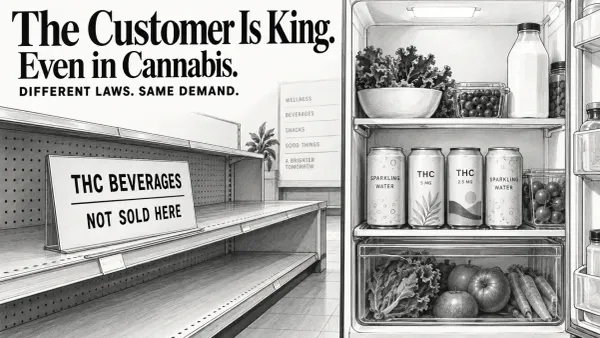
Why can I buy THC beside the beer at one store but need three identification checks to purchase it at another?
What is the difference between hemp THC and marijuana THC?
The translation channels between the legal industry and the public remain remarkably weak.
That is especially dangerous as intoxicating beverages and edibles enter conventional retail settings. A five-milligram drink is one proposition. A package containing 50 milligrams is another. The label may technically disclose the difference without genuinely communicating it to an inexperienced buyer.
The last thing this industry needs is Maureen Dowd 2.0 because somebody pushed the dosage envelope and ultimately mailed the letter to themselves.
Rikki, don’t lose that number.
A modest proposal for the beverage cowboys
The trade associations that claim to organize the intoxicating-hemp beverage industry should prove it.
Establish enforceable best practices before somebody else establishes them for you.
No beverage or package above 10 milligrams should enter an ordinary retail environment without clear and comprehensive communication among producer, retailer and consumer concerning:
- Milligrams per serving.
- Total milligrams per container.
- Expected onset time.
- Warnings against rapid redosing.
- Guidance for inexperienced consumers.
- Age verification.
- Independent testing.
- Responsible placement and merchandising.
The rules may never be as arduous as those imposed on state-licensed cannabis companies.
They should nonetheless exist.
A legal industry cannot indefinitely argue that prohibition creates an illicit market while refusing to demonstrate what responsible legalization looks like.
Festivus for the rest of us
This brings us—through an entirely transparent sequence of thoughtful observation masquerading as journalism—to something we are selling.
Perhaps LinkedIn and newsletter publishers should establish best practices for that too.
On October 8 at Sarabande in Chicago, the Grown In Harvest Exchange will bring together licensed operators, hemp participants, lawmakers, educators, investors, consumers, civic leaders, mayoral candidate and longtime Grown In pontificator Matt Brewer, other political voices and a professionally useful assortment of industry weirdos.
Not another earnings call.
Not another dispensary ribbon cutting.
Not another conference at an airport hotel where everybody agrees that the plant deserves a seat at the table without deciding who is responsible for setting the table.
A Festivus for the rest of us.
We will discuss what Schedule III actually changes, what it does not, what happens to intoxicating hemp, how cannabis enters mainstream consumer life, what Chicago and Illinois should do next and how the people building this economy can behave like the industry they keep asking lawmakers and investors to recognize.
Convene.
Consume responsibly.
Transact.
Translate.
And build the industry we claim we are ready to become.
Grown In Harvest Exchange
October 8, 2026
Sarabande | Chicago
No hotels. No greenfields.
Just the river, the plant and the people responsible for what happens next.
Do it.