Welcome to the Machine: The New York Times, Donald Trump and the Government’s Very Confusing War on Weed

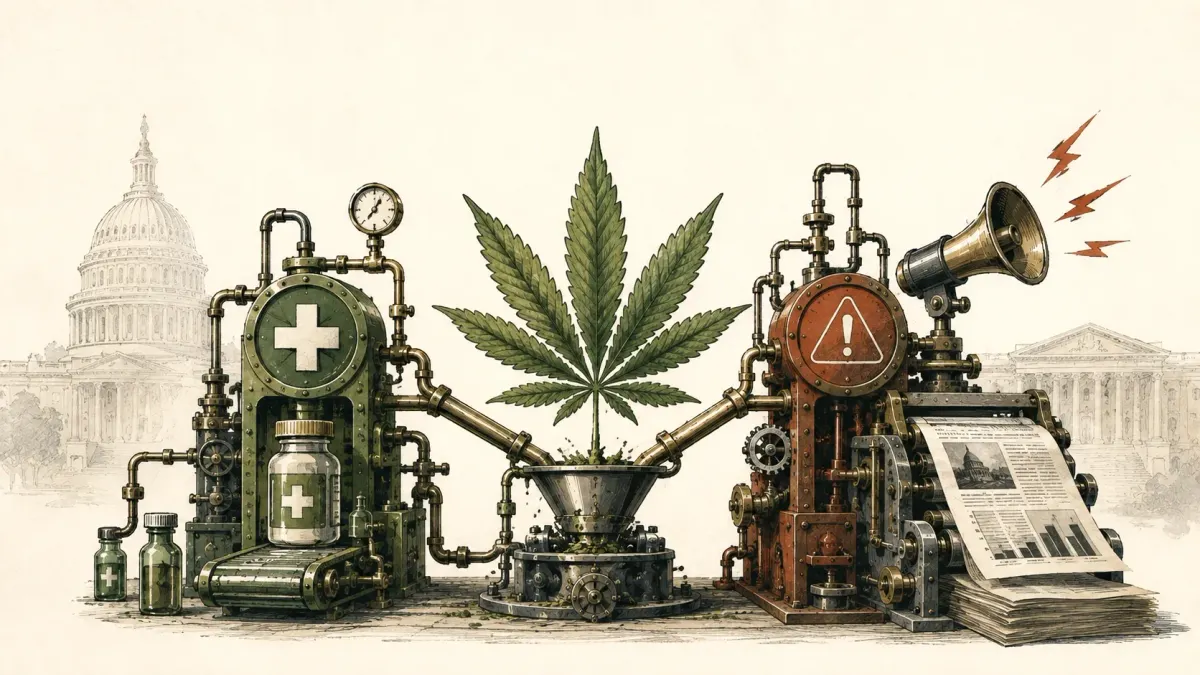
A federal government simultaneously studying cannabis addiction, recognizing marijuana as medicine and trying to save your five-milligram THC seltzer walks into The New York Times. Somehow only one of those stories sounds scary.
Let us begin with a sentence that would have sounded insane at almost any point during the last 40 years:
Donald Trump may be one of the most consequential pro-cannabis presidents in American history.
Please do not misunderstand me.
I haven't particularly liked the guy since he showed up in the United States Football League in the early 1980s and helped turn a perfectly entertaining spring football experiment into another chapter in the Donald J. Trump Extended Universe.
Nothing since has caused me to purchase the red hat.
But cannabis is cannabis, facts are facts, and the current facts are weird.
Trump has directed his Justice Department to accelerate the move of marijuana toward Schedule III. His administration has formally recognized medical uses of marijuana that the federal government spent decades pretending did not exist. It has called for more real-world evidence about marijuana and CBD. And this summer, the White House has even been involved in the strange bipartisan effort to buy intoxicating-hemp businesses a little more time before a federal crackdown potentially wipes low-dose THC beverages off convenience-store and liquor-store shelves.
At roughly the same moment, Donald Trump's National Institutes of Health is funding research warning us that more Americans have something called Cannabis Use Disorder.
And The New York Times — which spends no small amount of journalistic energy asking readers to question, interrogate and occasionally fear Donald Trump's federal government — looks at this particular piece of federal government work and more or less says:
Yes. This seems correct. The cannabis problem is getting worse. Next question.
Welcome to the machine.
THE GOVERNMENT SAYS WEED IS MEDICINE. ALSO, PLEASE SEEK TREATMENT FOR WEED.
On August 19, the Times published a health story headlined:
“As More Americans Turn to Cannabis, Problem Use Is Increasing.”
The underlying research is real.
It appeared in JAMA Psychiatry. It analyzes a large federal dataset, the National Survey on Drug Use and Health. And it finds an increase in the percentage of American adults meeting the diagnostic criteria for Cannabis Use Disorder between 2021 and 2024.
That deserves coverage.
But here is where Neil Postman should materialize from the great seminar room in the sky and start asking annoying questions.
Who is doing the looking?
The study's authors work at the National Institute on Drug Abuse.
NIDA sponsored the research.
Its director, Dr. Nora Volkow, is the paper's senior author.
And the Times story turns heavily to Volkow to explain what the study means.
There is nothing sinister about this. NIDA studies drug abuse. That's the assignment.
But the assignment matters.
If you send the National Institute on Drug Abuse into America looking for drug-use disorders, it would be somewhat surprising if they came back with a report about how pleasant everyone found the Grateful Dead concert.
Institutions see what their instruments permit them to see.
That was one of Postman's enduring observations about media and technology: the tool is never neutral because every tool contains an idea about what is worth noticing.
NIDA's instrument is addiction science.
The Times health desk's instrument is health risk.
The DSM's instrument is diagnosis.
And suddenly a person sitting on the porch every evening drinking a THC seltzer starts to look less like a citizen relaxing after work and more like a data point moving toward pathology.
Maybe that person has a problem.
Maybe that person doesn't.
The interesting journalistic work begins right there.
Instead, that's roughly where this Times story stops.
FIRST, DEFINE THE PROBLEM
The Times told readers that about 30 percent of past-year cannabis users showed symptoms consistent with Cannabis Use Disorder.
Thirty percent!
Now that's a number.
It practically writes its own push notification.
Except CUD is not synonymous with the word most ordinary people hear when they read that sentence:
addict.
Under the DSM framework used here, Cannabis Use Disorder can be classified as mild with only two or three criteria.
Those criteria include things ranging from unsuccessful efforts to cut down, craving and tolerance to considerably more consequential behavior such as neglecting responsibilities, dangerous use and continuing despite serious physical or psychological harm.
Those distinctions matter.
Indeed, readers noticed.
One Times commenter complained that an entire article about Cannabis Use Disorder did not actually give readers the full definition of Cannabis Use Disorder.
Reporter Roni Caryn Rabin subsequently posted all 11 criteria — in the comments section.
Think about that as media ecology for a moment.
The headline gives you the fear.
The article gives you the statistic.
The diagnostic context shows up below the story after a reader asks for it.
That is not misinformation.
It is something subtler and, to me, more interesting:
information architecture.
What goes at the top?
What gets compressed?
What gets omitted?
What arrives only after somebody complains?
Those choices create meaning.
THE NUMBER IS ALSO MORE COMPLICATED THAN THE HEADLINE
Here is another thing the Times could have spent more time explaining.
Among men who had actually used cannabis during the previous year, the percentage meeting the CUD criteria increased significantly.
That's important.
But among women who had used cannabis, the increase was not statistically significant.
In other words, part of the rise in Cannabis Use Disorder across the general population is exactly what common sense would predict:
More Americans are using cannabis. Therefore more Americans will meet criteria for problematic cannabis use.
That does not make the problem imaginary.
More driving creates more automobile accidents, too. We still care about automobile accidents.
But there's an enormous difference between:
More people are using a substance, therefore more people experience problems with it
and
The substance itself appears to be becoming dramatically more addictive.
Those are different claims.
The Times story lets them blur together.
Then comes potency.
Volkow argues that today's high-THC products may be revealing cannabis' addictive potential.
That is a plausible hypothesis, supported by other research worth discussing.
But this particular study did not measure what THC percentage each respondent consumed.
It did not establish that potency caused the increase.
Yet potency enters the story almost immediately as explanatory reality.
Again:
Not necessarily false.
Not demonstrated here either.
WHERE ARE THE WEED PEOPLE?
This may be the strangest part.
The Times didn't technically rely upon a single source. It talked to multiple experts.
But intellectually, the story feels remarkably single-source.
Everybody is standing on approximately the same side of the telescope.
Addiction researcher.
Public-health researcher.
Addiction researcher.
Where is the epidemiologist whose job is to interrogate the denominator?
Where is the DSM critic?
Where is the medical-cannabis physician?
Where is somebody studying substitution away from alcohol?
Where is somebody who studies benefits as well as harms?
Where is the regulated cannabis operator who can explain what consumers are actually buying?
Where is the 62-year-old woman who takes five milligrams before bed and hasn't had a glass of wine in three years?
Where is the guy who smoked every night for 30 years and then went to Ireland for ten days and simply didn't?
None of those people get to invalidate epidemiology with personal experience.
But lived experience is data about questions we haven't learned how to ask yet.
Journalism used to understand that distinction.
A reporter didn't merely call the official institution that produced a report and then call two people professionally adjacent to the institution to explain why the report mattered.
You went outside.
You looked for the person who said the report was wrong.
You looked for the person who said it was right for the wrong reason.
You looked for the person whose life did not fit the categories.
Then you came back and told us what you found.
That's reporting.
Otherwise, we're getting dangerously close to transcription.
AND HERE COMES DONALD TRUMP, CANNABIS REFORMER
Which brings us to the funniest possible character in this story.
Donald J. Trump.
The same federal government producing Cannabis Use Disorder research is simultaneously dismantling pieces of the federal government's own 50-year cannabis worldview.
Trump issued an executive order saying, in remarkably plain language, that decades of federal drug policy had neglected marijuana's medical uses.
His administration has pushed forward Schedule III.
The Justice Department has now taken consequential action recognizing state-regulated medical marijuana within a Schedule III framework.
And the White House has asked for more real-world evidence about cannabis.
Real-world evidence!
Somewhere, a Times commenter should frame that phrase.
Because what is missing from so much cannabis journalism is precisely the world where cannabis is actually being used.
Not marijuana circa 1986.
Not a 27-percent concentrate in a laboratory.
Not Nancy Reagan's America.
America, 2026.
The 55-year-old replacing the third bourbon with a THC beverage.
The cancer patient.
The person who takes too much.
The person who takes too little.
The kid who should not be taking any.
The dispensary selling 30-percent flower.
The bartender pouring tequila.
The corner store selling an untested mystery gummy.
The Minnesota brewery putting five milligrams of THC into a 12-ounce can.
These are not the same thing.
Yet our public vocabulary continually compresses them into one magic noun:
Cannabis.
MAYBE THE MEDIUM HAS A CANNABIS PROBLEM
This isn't an Ochs-Sulzberger family conspiracy.
In fact, that theory collapses pretty quickly.
The New York Times editorial board famously supported marijuana legalization more than a decade ago. It still broadly favors legal adult access while now arguing for considerably tougher regulation.
Good.
People and institutions are allowed to change their minds.
But perhaps another institutional force is operating here.
The Times is no longer merely a newspaper.
It is a giant digital subscription machine delivering news, video, podcasts, recipes, games, health advice and warnings directly into our nervous systems all day long.
Health journalism operates particularly well in that environment.
Is coffee killing you?
Click.
Is red wine actually good for you?
Click.
Should you stop taking melatonin?
Click.
One in three cannabis users may have a disorder.
Oh boy.
I'm not saying somebody in a Times conference room decided anti-weed stories sell subscriptions.
I am saying that every medium develops forms of storytelling that fit its economic and technological environment.
Postman would ask us to notice that.
An ambiguous finding is difficult to package.
A clearly identified threat works beautifully.
The strange thing is that the Times generally recognizes this problem when Donald Trump is the subject.
A Trump administration statistic requires context.
A Trump administration assertion requires adversarial sourcing.
A Trump administration scientific claim deserves to have its methodology kicked around.
As it should.
So why does cannabis apparently suspend the instinct?
Why does a study financed and authored inside Trump's NIH become something closer to gospel when the subject is weed?
MAYBE THE ANSWER IS THAT WE STILL DON'T KNOW HOW TO TALK ABOUT WEED
For 50 years America basically had two cannabis languages.
The government language said:
Dangerous drug.
The counterculture language said:
Relax, man. It's weed.
Neither is sufficient anymore.
Cannabis is legal commerce.
Cannabis is medicine.
Cannabis is recreation.
Cannabis can create dependence.
Cannabis can reduce suffering.
Cannabis can trigger psychosis in susceptible people.
Cannabis can replace alcohol for some consumers.
Cannabis can be dramatically overconsumed.
Cannabis can also be five milligrams in a sparkling water.
All of these things can be true simultaneously.
That's the Middle Ground.
Not “weed is good.”
Not “weed is bad.”
Tell us what happened. Tell us compared with what. Tell us at what dose. Tell us among whom. Tell us who paid for the research. Tell us what the research actually measured. Then go find somebody who sees it differently.
And for God's sake, if your article is about Cannabis Use Disorder:
put the definition of Cannabis Use Disorder in the article.
Donald Trump, of all people, seems to have stumbled into a federal cannabis policy that acknowledges contradiction.
Medicine and risk.
Access and regulation.
Research and real-world experience.
Legal cannabis and restrictions on genuinely dangerous products.
Perhaps The New York Times could try the same thing.
Because after 40 years of Nancy Reagan, D.A.R.E., Cheech & Chong, dispensary billboards, gummy bears, Schedule I, Schedule III, CBD, THC, hemp loopholes and one extremely confused federal government, Americans probably don't need another institution telling them simply to be afraid of marijuana.
They need journalism.
And journalism, unlike weed, should occasionally make us a little uncomfortable.