Meet the New Boss, Same as the Old Boss


The defining struggle of the next era may not be between innovation and regulation. It may be between institutions that claim to represent the public interest and the public's ability to participate in defining what that interest actually is.
Consumers are not merely the final destination of innovation. They are often the ones discovering what innovation is actually for.
Consider what happened Thursday in Chicago.
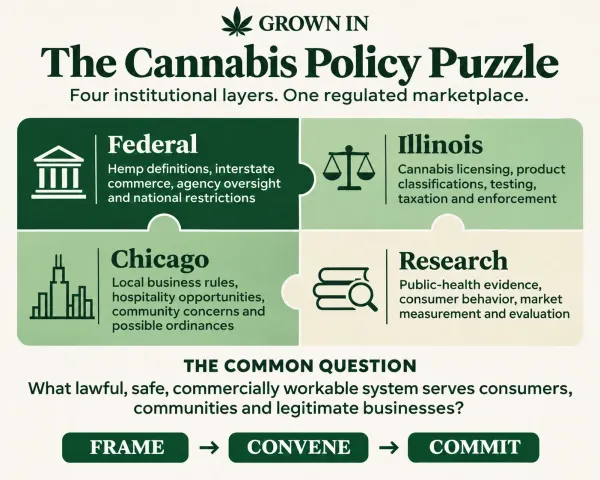
A federal judge declined to halt Illinois' new restrictions on intoxicating hemp products, leaving a rapidly expanding market for THC beverages largely confined to licensed cannabis dispensaries.
Hundreds of businesses that helped introduce cannabis to an entirely new class of consumers now confront a future determined by regulators and a licensed industry that didn't create their market.
Meanwhile, Minnesota Governor-elect Amy Klobuchar is working with Republican colleagues on a federal alternative before a December 11 deadline threatens much of the national hemp beverage industry.
The irony is difficult to miss.
The cannabis movement, born from decades of challenging prohibition and expanding access to a plant humans have used for thousands of years, has matured into a licensed industry whose regulatory framework now restricts access to some of its most popular new products.
The disruptors have become gatekeepers.
And just as this adolescent industry struggles to reconcile its founding principles with the responsibilities and financial realities of an established marketplace, artificial intelligence is undergoing a remarkably similar transformation.
Only considerably faster.
The revolution goes public
Thursday also marked Anthropic's debut on Wall Street, five years after seven researchers departed OpenAI to establish a company dedicated to developing artificial intelligence without sacrificing humanity's future.
A noble mission. And an increasingly lucrative one.
Anthropic's founders now hold extraordinary wealth, and their public benefit corporation must navigate the competing interests of investors, employees, regulators and the billions of people whose lives its technology may soon transform.
None of this makes their original mission insincere.
But a public benefit corporation is still a corporation. Capital has expectations. Shareholders have rights. And even the most carefully constructed governance systems must contend with financial realities.
The mission hasn't necessarily changed. It just has company.
We've spent the better part of the Information Age watching this transformation unfold.
The internet began as an open frontier promising to democratize information. It matured into an ecosystem dominated by enormous platforms exercising extraordinary influence over what people see, say and understand.
Artificial intelligence is compressing much of that institutional evolution into a few years.
The developers who challenged the existing order are rapidly acquiring the resources and authority to determine who participates in the next one.
Sound familiar?
Cannabis and the cost of winning
Long before cannabis became an investment category, it was a cause.
Medical marijuana pioneers challenged criminalization, incarceration, scientific ignorance and the arbitrary distinction between acceptable and unacceptable ways for adults to alter their consciousness.
The movement was about medicine, dignity and access.
Eventually, the pioneers won.
States legalized medical cannabis. Adult-use markets followed. Licenses were awarded. Capital flowed. Regulators built agencies, companies built brands and investors began calculating returns.
A legitimate industry emerged from an underground economy.
That was progress.
But something happened along the way.
The movement that challenged the government's authority to prohibit cannabis became an industry dependent on the government's authority to license it.
And as those licenses acquired economic value, the boundaries of the regulated marketplace became increasingly important to the businesses operating within it.
Then consumers did something inconvenient.
They discovered another way to participate.
Hemp-derived THC beverages emerged as a familiar, often lower-dose alternative to alcohol. They appeared in bars, restaurants, breweries and neighborhood stores, bringing cannabis into social environments that licensed dispensaries had never fully reached.
Not everyone wanted to visit a dispensary. Not everyone thought of cannabis as medicine. And not everyone wanted to buy a product whose retail experience remained closely associated with decades of prohibition.
Some people simply wanted a drink.
Consumers were ahead of the regulators. And ahead of the disruptors who had become the establishment.
Illinois' response has been to bring most intoxicating hemp products under the existing licensed cannabis system, sharply limiting their sale through conventional retailers.
There are legitimate reasons to regulate these products. Testing, labeling, age verification and responsible marketing are essential. Licensed cannabis operators reasonably question why competitors should be allowed to sell similar intoxicating substances under different rules.
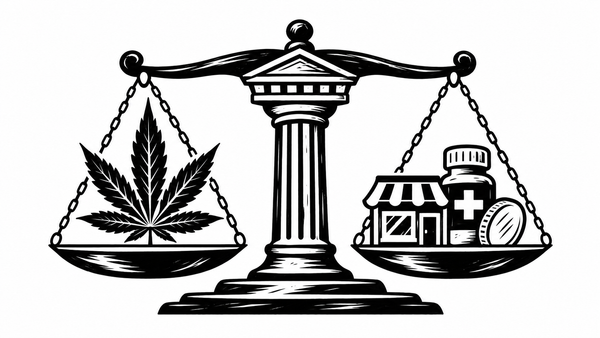
But consumer protection and protection of incumbent businesses are not interchangeable objectives.
And a system designed to expand legal access should be especially careful about narrowing it.
Two lanes, one public
Perhaps the most important development in cannabis isn't that the industry is dividing into medical and recreational markets.
It's that consumers are forcing us to reconsider what those markets were supposed to accomplish in the first place.
Medical cannabis emerged from a demand for dignity, treatment and relief. Patients need reliable formulations, consistent dosing, professional guidance and protections that recognize therapeutic use rather than treating every purchase as discretionary consumption.
Recreational cannabis is something different. It's not necessarily about getting high, any more than every adult who orders a beer is trying to get drunk. It's about choices, experiences, social rituals and the freedom to decide how a substance fits into one's life.
For decades, cannabis policy largely ignored those distinctions. Prohibition treated nearly everyone as a criminal. Medical legalization established a narrow path to legitimacy. Adult-use legalization expanded that path but often retained the assumptions, infrastructure and market boundaries of the medical system that preceded it.
Then came beverages.
And consumers began drawing their own map.
The question was no longer simply who qualified to purchase cannabis or which state-licensed establishment could sell it.
It became where, how and why ordinary adults wanted to participate.
That's a much bigger cultural question than whether a THC beverage belongs behind a dispensary counter.
The medical and recreational lanes will continue to overlap, and they should. But their emergence should reflect the different needs of the people using cannabis, not merely the convenience of the agencies regulating it or the companies selling it.
Consumers are not merely the final destination of innovation. They are often the ones discovering what innovation is actually for.
That's as true of a five-milligram THC beverage as it is of artificial intelligence.
The people building and regulating these markets may understand their technologies better than anyone. But understanding a technology isn't the same as understanding every way people will choose to use it.
That discovery belongs to the public.
And when institutions begin treating consumer behavior as an inconvenience to be managed rather than information to be understood, something important has gone wrong.
The rest of us
Over the past ten days, Americans have watched disruptions ripple through aviation, banking and technology systems, exposing vulnerabilities in an Information Age whose underlying infrastructure remains an unfinished project.
Artificial intelligence arrives at precisely this moment, offering unprecedented tools to understand and improve those systems while introducing new concentrations of economic and institutional power.
We've been living inside the building while the contractors were still working.
Now someone wants to redesign it.
And the people holding the blueprints are becoming extraordinarily wealthy.
None of this requires a conspiracy. It barely requires a meeting.
Just a noble mission, a business model, a few billion dollars and enough time for the people who challenged the old rules to start defending the new ones.
But there's an important distinction between today's institutions and the entrenched establishments of previous generations.
They're still growing up.
The licensed recreational cannabis industry is barely a teenager in most states. The commercial AI industry is younger still.
Their governing structures, economic incentives and relationships with the public are not settled facts of nature. They are choices being made, contested and revised in real time.
Which means the responsibility cannot rest entirely with the entrepreneurs, regulators and investors making those choices.
The onus is on us.
Not simply to demand that companies act responsibly or governments write better rules, although both are necessary.
But to insist on participating in the decisions that shape the systems we increasingly depend upon.
Consumers are not passive beneficiaries of innovation. Citizens are not spectators at the creation of the public interest.
They're supposed to be the reason these institutions exist.
For all the extraordinary tools now available to connect, inform and organize people, we've become remarkably comfortable outsourcing the definition of progress to the people who own or regulate its infrastructure.
Maybe that's the habit this next era must finally break.
Pete Townshend offered a warning about revolutions in 1971.
Meet the new boss. Same as the old boss.
Remarkably, The Who themselves are scheduled to perform at the 2027 New Orleans Jazz & Heritage Festival, apparently still not feeling quite old enough to die as a band, despite having already embarked on a farewell tour.
Then again, perhaps the secret to their longevity was understanding the relationship between Mother Nature, youthful rebellion and the authorities who occasionally insisted on busting everybody.
They addressed that subject in Tommy, with “We're Not Gonna Take It.”
Somehow, more than half a century later, the song still fits.
The question isn't whether the revolutionaries will eventually become the establishment.
They probably will.
It's whether the rest of us will recognize that the revolution was never theirs alone.
And whether this time, we refuse to get fooled again.