Chicago, We Have a Method. Now We Need a Cannabis Policy.

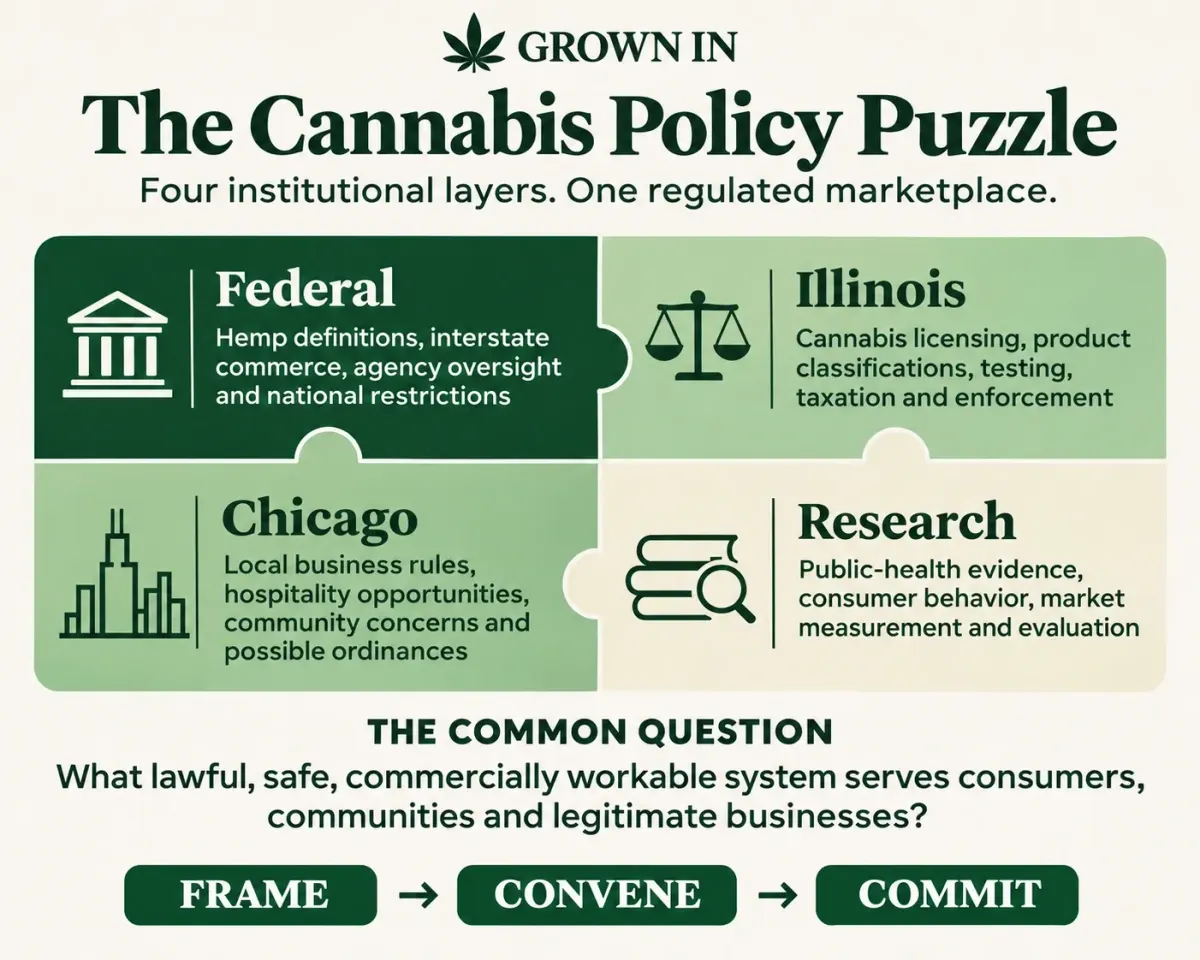
As Illinois redraws the rules for THC beverages, the more consequential question is how Chicago, Springfield and Washington organize the next chapter of a multibillion-dollar industry.
Today, November 12, 2026, Illinois is changing what it means to sell cannabis.
Not grow it. Not consume it. Not necessarily even manufacture it.
Sell it.
Under the state's new hemp law, most intoxicating THC beverages and related products can no longer be sold through the restaurants, breweries, liquor stores and other businesses that helped create the market. Products containing more than 0.4 milligrams of total THC per container are now classified as cannabis and subject to Illinois' existing cannabis regulatory framework.
A federal lawsuit has bought some businesses a little more time, with a temporary enforcement pause pending a November 19 hearing. But the reprieve is limited. The underlying law remains in place.
It's a consequential moment for thousands of Illinois entrepreneurs, employees, patients and consumers.
And it raises a question considerably larger than whether your neighborhood bar can still sell a five-milligram THC seltzer.
What kind of cannabis economy are we actually trying to build?
A Festivus airing of grievances
Last month, Grown In assembled dozens of cannabis stakeholders at our Fall Harvest Exchange, including our industry Festivus: an opportunity for people with competing and complementary interests to say what was working, what wasn't and what they wanted to change.
Dispensary operators, hemp entrepreneurs, policy advocates and others didn't agree on everything.
That wasn't the point.
The point was to demonstrate that a mature industry ought to be able to argue about its future without treating disagreement as disloyalty.
We thank state Rep. Will Guzzardi and the other participants who contributed to those conversations.
Guzzardi, a sponsor of Illinois' hemp legislation, offered an especially interesting perspective during WTTW's Chicago Tonight this week.
He acknowledged that he would welcome a world in which low-potency THC beverages and edibles were available beyond licensed dispensaries, while noting that impending federal rules complicate that possibility.
That's not an endorsement of an immediate new hospitality channel. Nor does it settle the legal obstacles.
But it recognizes that the conversation shouldn't end with today's restrictions.
A law can close one door without resolving what ought to be built behind it.
Two lanes, one plant
Perhaps our governing problem begins with insisting that cannabis is one market.
It isn't.
Consider two distinct populations.
Patients use cannabis for therapeutic purposes. Their needs implicate clinical evidence, medical advice, product consistency, access, affordability and the standards by which treatments are evaluated.
Adult consumers may use cannabis recreationally, socially or as an alternative to alcohol. Their needs raise different questions about age limits, dosage, labeling, hospitality, consumer choice and responsible retail.
Some people occupy both categories. And the same product can cross the boundary depending on why someone uses it.
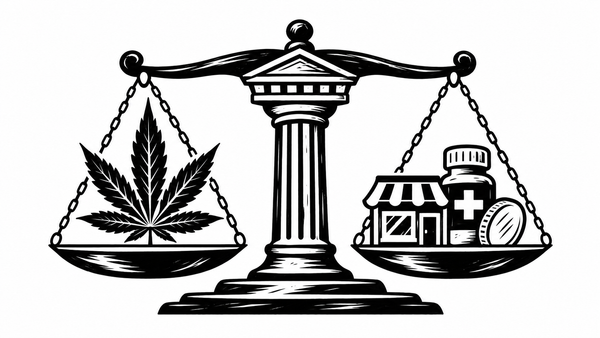
But that doesn't mean every transaction belongs under an identical regulatory or business model.
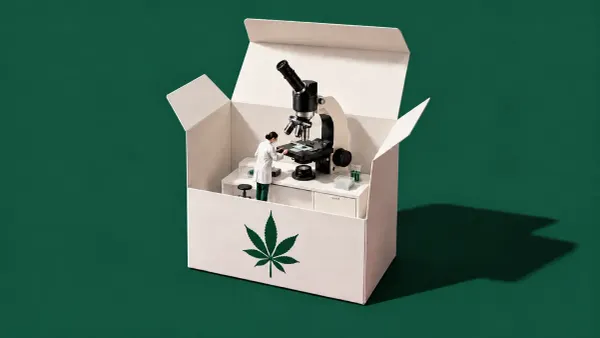
Medical cannabis should have a credible path toward rigorous research, clinical standards and appropriate federal health oversight.
Adult-use cannabis needs rules proportionate to the product's risks, including enforceable consumer protections and meaningful distinctions among products with very different potencies.
Neither lane should become an excuse to abandon public health.
Neither should be forced to carry every assumption attached to the other.
The long-term opportunity is a system that recognizes the differences without manufacturing unnecessary barriers between them.
Chicago has more than a little experience here
Illinois didn't invent legal cannabis.
But its 2019 adult-use legalization framework helped demonstrate how a major state could combine commercial licensing, taxation, social-equity provisions, community reinvestment and regulatory oversight.
New York and other states have since developed their own approaches, sometimes with similar aspirations and very different implementation challenges.
Illinois has lessons to contribute. It also has mistakes to acknowledge.
Its cannabis market remains enormous, but lower prices, pressure on licensed businesses and persistent unregulated competition complicate the economics. State cannabis revenue collections declined from approximately $474 million in fiscal 2025 to $456 million in fiscal 2026.
That's not an industry to dismiss as a novelty.
It's an established part of the state's economy with a substantial community of experienced practitioners, researchers, regulators and entrepreneurs.
And Chicago is home to an unusually deep concentration of that expertise.
Which brings us to City Hall.
The next mayor—or a reelected Brandon Johnson—will inherit this issue alongside education, public safety, technological change and the city's persistent fiscal challenges.
Cannabis may not rank among the campaign's three most prominent subjects.
But it could become an important test of whether Chicago knows how to translate an existing industry into jobs, responsible commerce, neighborhood opportunities and practical public policy.
Aldermen, including William Conway, have an opportunity to investigate what local cannabis hospitality, business development and public-health initiatives might reasonably look like under current state law—and what changes would require Springfield's approval.
Chicago cannot legislate away federal restrictions or create an independent exemption from state cannabis law.
It can, however, organize the evidence, identify workable options and help make the case for change.
Who's calling the play in Springfield?
Governor J.B. Pritzker has become the most visible public advocate for Illinois' cannabis policy direction.
The Cannabis Regulation Oversight Office, meanwhile, continues its formal work across agencies and recently published a substantial annual report.
Its relative absence from some of the most visible public exchanges over the hemp transition leaves an interesting question: Who is responsible for coordinating the state's next phase of cannabis policy in a way that stakeholders can understand and influence?
And how are the lessons from Illinois' cannabis research institutions and industry being integrated into those decisions?
Research efforts in Illinois, Colorado, California and potentially Missouri offer opportunities to improve evidence around public health, consumer behavior and regulated-versus-unregulated markets.
Those efforts won't produce one national answer overnight. Different state policies, data systems and research priorities complicate comparison.
But they create the possibility of something cannabis policy has often lacked: an evidence base developed across jurisdictions rather than a collection of competing political claims.
That work could ultimately help inform federal agencies, including the FDA, as national regulatory approaches evolve.
Washington gets the attention. Springfield does the work.
The national cannabis conversation is increasingly entangled with the Trump administration, federal hemp definitions, pharmaceutical interests, campaign politics and the commercial ambitions of a sprawling industry.
Much of that industry's networking and dealmaking gravitates toward Las Vegas.
Nothing wrong with a convention in the desert.
But it's worth remembering that important institutional change doesn't always emerge from the biggest stage or the most heavily sponsored reception.
Sometimes it happens in a state legislative committee room, where competing interests eventually have to agree on statutory language, agency responsibilities and who pays for implementation.
Twenty years ago this coming February, Barack Obama stood outside the Old State Capitol in Springfield and announced a presidential campaign premised partly on the possibility of overcoming entrenched divisions.
Cannabis policy is a considerably smaller subject.
But the civic challenge is recognizable.
Can people with opposing interests create a framework that protects consumers, supports legitimate enterprise, advances research and produces results that survive the next election?
Grown In's Festivus demonstrated that people are willing to have the difficult conversations.
Now the institutions have to catch up.
Frame the problem. Convene the competing interests. Commit to something that works.
Chicago has the people. Illinois has the experience. Washington has a role it can no longer indefinitely avoid.
The next chapter shouldn't be written exclusively by prohibitionists, industry lobbyists, medical researchers or politicians.
It should be informed by all of them—and accountable to the people who will actually live with the results.
Chicago, we have a method. Let's build a better market.