AI + THC = BS

Or: The Lotus Eaters, Lotus Notes and Our Long, Strange Odyssey Home
If somebody tells you they have figured out AI + cannabis, hold onto your wallet.
Not because artificial intelligence is bullshit.
Not because cannabis technology is bullshit.
Not even because a considerable amount of what is currently marketed under both categories is, technically speaking, bullshit.
Rather:
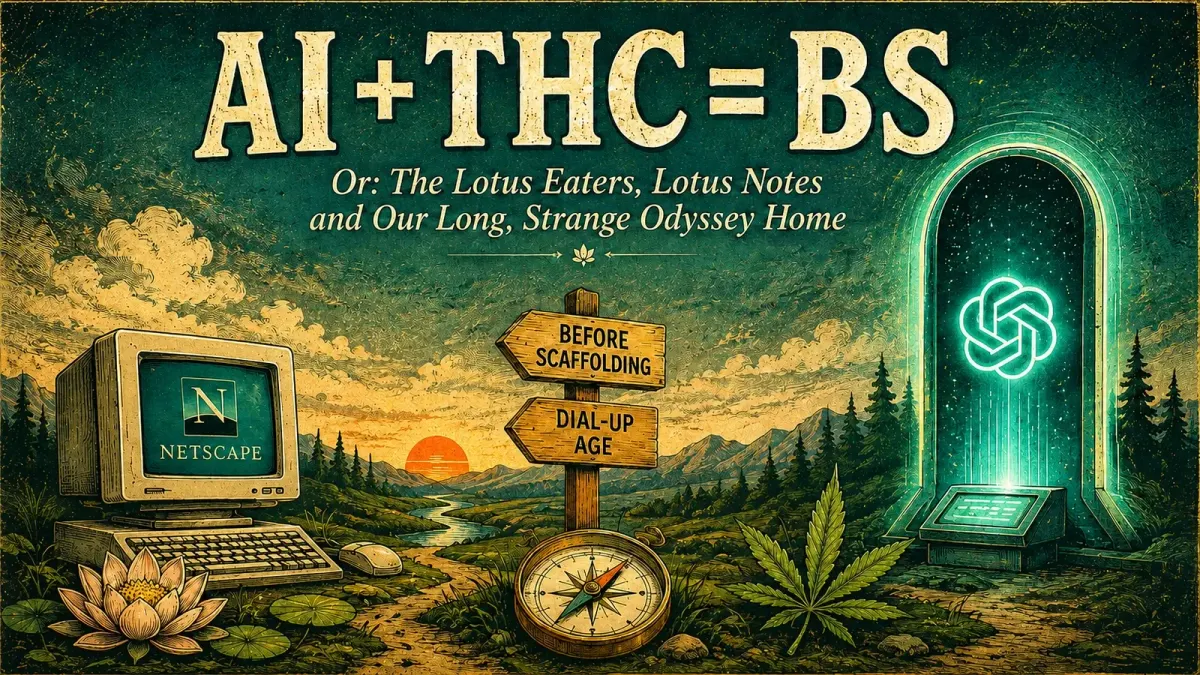
AI + THC = BS because we are still Before Scaffolding.
We are trying to hang chandeliers in two houses whose foundations are still being poured.
Artificial intelligence is somewhere around the dial-up stage of becoming the dominant interactive medium of our age.
Cannabis, meanwhile, is perhaps 10 or 15 years into the considerably stranger project of becoming a legitimate American industry while remaining federally illegal, state-regulated, culturally ancient, medically consequential, recreationally popular and—thanks to intoxicating hemp—occasionally available between the Doritos and lottery tickets.
And now we are going to combine the two?
Excellent.
What could go wrong?
Please Explain This Like We Are Children
Many of my advisers have recently encouraged me to dumb things down.
Fair enough.
So children, gather around.
Once upon a time there was something called the Internet.
Before the Internet, when you wanted to know something, you called somebody who knew it.
Or went to a library.
Or bought a newspaper.
Or, in an emergency, asked the bartender.
Then came the browser.
In the particular media-ecology calendar observed here at Grown In, the Internet Age began on August 9, 1995, when Netscape went public.
This is not merely myth-making. Netscape really did stage its transformational IPO that day.
And Jerry Garcia really did die on August 9, 1995.
Same day.
You can't make this stuff up.
Well, artificial intelligence can.
But we didn't.
Netscape's browser gave normal humans a way to navigate a network that had previously belonged disproportionately to scientists, academics, government researchers and people who knew what ftp meant.
Jerry and the Grateful Dead had spent several decades demonstrating another way networks could operate: decentralized, improvisational, occasionally chemically assisted, highly participatory and suspicious of anybody claiming to completely control the experience.
The browser met the Dead.
The Internet Age began.
At least according to us.
And Then Bobby Died
All heroic stories need bookends.
So we'll give the Internet Age another one.
On January 10, 2026, Bob Weir died at 78. A few hours later, the Chicago Bears somehow defeated the Green Bay Packers 31–27 in an NFC Wild Card game.
This does not scientifically prove that the Internet Age ended that weekend.
But neither did Homer submit The Odyssey for peer review.
Myths organize experience.
And our media ecology had clearly changed.
By then most of us were no longer primarily browsing the network.
We were beginning to ask it questions.
The browser was becoming subordinate to the answer machine.
November 30, 2022: The Mosaic Moment for AI
Artificial intelligence existed long before ChatGPT.
The Internet existed long before Netscape.
That's the point.
The transformational moment isn't necessarily when a technology is invented.
It's when somebody puts an interface on it that millions of ordinary people can use.
OpenAI released ChatGPT on November 30, 2022.
That was AI's Mosaic/Netscape moment.
Suddenly you didn't need to be a machine-learning researcher to experience a large language model.
You could type:
“Explain quantum computing to me like I'm 11.”
Or:
“Write me a breakup letter in the voice of Abraham Lincoln.”
Or:
“Why aren't my gummies selling in Peoria?”
And something answered.
Sometimes brilliantly.
Sometimes incorrectly.
Sometimes brilliantly and incorrectly, which is a particularly important category.
The interface changed.
And when the interface changes, behavior changes with it.
That is media ecology.
We Are in the Dial-Up Age of AI
People old enough to remember the early commercial Internet may recall an extraordinary period when every company suddenly needed an “Internet strategy.”
Nobody knew what that meant.
Consultants knew least of all, which did not inhibit billing.
Every organization needed a website.
Every website needed a portal.
Every portal needed a community.
Every community needed eyeballs.
Every set of eyeballs apparently justified a venture-capital valuation.
Pets.com briefly became an economic theory.
We are there again.
Except now everything needs an AI strategy.
AI cultivation.
AI compliance.
AI loyalty.
AI menus.
AI recommendations.
AI marketing.
AI supply chain.
AI budtenders.
AI forecasting.
AI yield optimization.
AI-powered intelligence to tell you that Strawberry Cough sells better when it is in stock.
Some of these tools are genuinely useful.
Cannabis operators are already experimenting with AI and automation in cultivation, compliance, retail, packaging, inventory and customer analysis. Flowhub, for example, is now explicitly connecting dispensary data with major AI assistants.
Good.
Build.
Experiment.
Measure.
But if somebody tells you in 2026 that they definitively know how AI will transform cannabis:
BS.
Before Scaffolding.
Because Cannabis Doesn't Have Its Scaffolding Either
This is where the story gets interesting.
Cannabis technology companies have already been on their own Odyssey.
They have spent the past decade-plus trying to build normal business technology for an abnormal business environment.
Point of sale.
Seed-to-sale.
Payments.
Banking workarounds.
Compliance.
ERP.
Advertising.
Data.
Loyalty.
Delivery.
Testing.
E-commerce.
Menu syndication.
Consumer analytics.
Brand discovery.
All while trying to answer an industry-specific version of one ancient question:
Are we legal yet?
Sort of.
Depends.
Which product?
Which state?
Which regulator?
Which molecule?
What day is it?
The state-licensed cannabis industry developed one technological stack.
The intoxicating-hemp marketplace developed another.
Consumers developed their own stack, generally involving whatever is easiest.
Now artificial intelligence arrives offering to optimize the whole thing.
Optimize what, exactly?
We're still deciding what the rules are.
Enter the Lotus Eaters
This is where Homer becomes useful.
Odysseus and his crew are trying to get home.
Along the way, some of the men encounter the Lotus Eaters.
They consume the lotus and lose interest in returning.
The journey stops mattering.
Home stops mattering.
Everything is pleasant enough right where they are.
Anyone who has spent significant time around either technology evangelists or cannabis enthusiasts may recognize certain elements of this story.
And then, because apparently the gods demand it, we arrive at:
Lotus Notes.
Children, Lotus Notes was software.
Grown-ups used it at work.
Long before Slack, Teams, Google Workspace and the rest of our cheerful contemporary surveillance apparatus, Lotus Notes helped organizations share messages, information and collaborative applications.
IBM's own history dates Lotus Notes to 1989 and describes it as a groupware and collaboration platform.
So we have:
Lotus Flower: ancient technology for altering consciousness.
Lotus Notes: late-20th-century technology for organizing consciousness.
Large Language Models: 21st-century technology increasingly outsourcing portions of consciousness.
Please tell me Homer wouldn't have enjoyed this.
AI + THC
Both technologies mediate perception.
One changes the informational environment around your brain.
The other changes, among other things, the way some people experience what's already inside it.
Neither is neutral.
Neither is inherently liberating.
Neither is inherently corrupting.
Both have benefits.
Both have risks.
Both can be extraordinarily useful.
Both can become crutches.
And both have industries surrounding them with strong economic incentives to tell us that more is generally better.
Neil Postman, under whom I was fortunate to study at NYU, spent much of his career asking us to look beyond what a technology does and ask what kind of environment it creates.
What does it amplify?
What does it diminish?
Who gains power?
Who loses it?
What problem did we think we were solving?
What new problems did solving it create?
Those seem like reasonable questions for both AI and THC.
A Brief Disclosure From Your Cannabis Compass
I've been wandering around frontier industries for a while.
Internet.
Web 2.0.
Nanotechnology.
Mobile.
Social.
SoLoMo—which, yes, was once a word people said out loud.
In 2012, I moderated a SoLoMo panel in Chicago that included a young entrepreneur named Sam Altman.
Then cannabis.
Alternative medicine and psychedelics.
Responsible AI.
Quantum computing.
And back to cannabis again.
During my time with the University of Illinois System's Discovery Partners Institute, I worked as part of an effort that helped establish the Cannabis Research Institute, subsequently supported by a three-year, $7 million Illinois Department of Human Services grant intended to produce independent academic research on cannabis.
That doesn't mean I possess the answers.
If anything, watching enough technological revolutions teaches the opposite lesson.
The people claiming certainty earliest are usually selling something.
Sometimes what they're selling becomes enormously valuable.
Sometimes it becomes Pets.com.
Usually we don't know which one yet.
Hence: AI + THC = BS
Again, not all bullshit.
Incremental applications are absolutely worth pursuing.
Can AI help a multistate operator forecast inventory?
Probably.
Can it help identify anomalies in compliance data?
Sure.
Can computer vision improve cultivation?
Yes.
Can better data help retailers understand consumer behavior?
Obviously.
Can AI help a budtender explain product categories or help a marketer develop creative?
Already happening.
Can it reduce administrative labor?
Certainly.
The useful questions are not particularly mystical:
Does it make something faster?
Cheaper?
Safer?
More compliant?
More understandable?
More profitable?
More humane?
And:
Can you prove it?
That last question is where some of the current AI incense begins to clear.
Beware the Oracle
Large language models are seductive because they answer.
Humans like answers.
Particularly executives.
Boards really like answers.
Investors love answers.
Journalists need answers by deadline.
Politicians need answers before the microphone moves to somebody else.
Cannabis entrepreneurs, after a decade of regulatory uncertainty, could be forgiven for desperately wanting an answer to almost anything.
And now we have a machine that will produce one instantly.
That doesn't make it an oracle.
It makes it a medium.
Sometimes an astonishing one.
But the danger in the AI age may not be that machines refuse to answer us.
It's that we stop noticing when we should have spent more time forming the question.
Maybe Smoke a Joint and Turn the Machine Off
This is not medical advice, nor a Grown In recommendation that THC belongs in everybody's bloodstream.
Different people respond differently to cannabis; impairment is real; dosage matters; age matters; context matters; dependency and adverse effects are real concerns.
But philosophically?
There is something amusing about building enormous computational systems to answer every imaginable question while humans simultaneously seek substances, meditation, walks, music, dinner with friends and occasionally a smoke circle to get their brains to stop answering questions for five minutes.
Perhaps abundance produces its own scarcity.
Information everywhere.
Attention nowhere.
Answers everywhere.
Wisdom still annoyingly manual.
And so, every once in a while:
Turn off the model.
Put down the phone.
Go outside.
Talk to another person.
Maybe they're wrong.
That's okay too.
The Journey Home
Odysseus was not trying to conquer every island.
He was trying to get home.
That's a useful frame for cannabis.
The destination is not maximum THC.
It is not maximum AI.
It is not maximum technology.
And it is definitely not maximum lobbying.
The destination is something approaching a legitimate, durable industry.
One where:
Consumers understand what they're buying.
Operators understand the rules.
Technology improves the product rather than disguising its shortcomings.
Researchers can study cannabis without ideological marching orders.
Regulators can distinguish consumer protection from prohibition nostalgia.
Companies can make money.
Workers can build careers.
Communities historically harmed by prohibition can participate economically.
And media can tell readers what is actually happening without becoming either industry stenographers or Reefer Madness revivalists.
That's home.
We are not there yet.
Which Is Why We're Putting AI + THC on the Table October 8
Rather than pretend Grown In has the answer, we're going to do something much more dangerous.
Put people with different answers in the same room.
At Grown In's Harvest Exchange featuring the Chicago Cannabis Congress on October 8 at Sarabande in Chicago, we're bringing together cannabis, hemp beverages, hospitality, technology, capital and public policy for a one-day working marketplace and congress.
And AI + THC belongs directly in that conversation.
Not:
“How Artificial Intelligence Will Revolutionize Cannabis.”
Please don't make me moderate that panel.
Instead:
AI + THC = BS: What Actually Works, What Doesn't, and What Nobody Knows Yet
Put the technology companies on stage.
Put operators beside them.
Put researchers there.
Maybe a regulator.
Maybe an investor.
Maybe somebody running a store who just wants to know whether this stuff saves three hours a week.
Ask:
What are operators actually paying for?
Where is AI producing measurable returns?
Where is it merely a new label on old analytics?
Who owns cannabis-industry data?
What should never be uploaded into a public model?
What happens when the model gives bad compliance advice?
Does cannabis have enough good structured data for these systems to deliver on the promises being made?
Which jobs disappear?
Which new ones emerge?
What needs a human being in the loop?
And perhaps most important:
What would change your mind?
That's a panel.
The Grown In Cannabis Compass
We don't need another oracle.
We need a compass.
A compass does not tell Odysseus what he will encounter.
It doesn't eliminate storms.
It doesn't kill Cyclopes.
It does not prevent your crew from making terrible decisions after several intoxicants.
It merely gives you some indication of direction.
That's increasingly how I see Grown In.
A cannabis compass for an industry navigating illegality-ish, technology, politics, commerce, culture, medicine and media transformation simultaneously.
We will get things wrong.
So will the AI.
So will regulators.
So will investors.
So will operators.
So will you.
The useful question is whether we can correct course before somebody convinces us that the lotus patch is Ithaca.
Respect the Journey
The Internet didn't arrive finished.
Cannabis didn't become an industry overnight.
AI won't either.