
FAQ
Intro: Cannabis Policy & Hemp Market FAQ
Clear answers to common questions about hemp-derived THC beverages, cannabis regulation, industry economics, and the evolving policy landscape shaping cannabis markets in the Midwest.
The cannabis industry sits at the intersection of federal law, state regulation, consumer products, taxation, and capital markets. This page is designed to make those issues easier to understand by answering common questions about hemp beverages, cannabis policy, regulatory structure, and the business forces shaping the industry.
For deeper analysis, explore Grown In’s coverage of hemp-derived products, Illinois regulation, cannabis economics, and Midwest market development.
Overview
The cannabis industry in the United States operates within a complex regulatory and economic framework. Federal law, state regulation, hemp-derived products, and rapidly evolving consumer markets all shape how cannabis businesses operate and how products reach consumers.
In recent years, the emergence of hemp-derived THC products, particularly beverages, has created a parallel market that exists outside traditional state cannabis dispensary systems. At the same time, licensed cannabis operators continue to navigate federal restrictions such as Section 280E taxation, limited banking access, and evolving regulatory oversight.
This FAQ provides clear explanations of some of the most common questions about cannabis policy, hemp-derived products, and the economics of regulated cannabis markets.
Key Points
• Hemp is legally defined as cannabis containing 0.3% delta-9 THC or less by dry weight under the 2018 Farm Bill.
• Cannabis with higher THC concentrations remains federally prohibited, even though many states regulate legal medical or adult-use markets.
• Hemp-derived THC beverages have created a growing consumer category outside traditional dispensary channels.
• Federal tax law—especially Section 280E—continues to shape the economics of cannabis businesses.
• Illinois, Michigan, Missouri, and Minnesota are among the Midwestern states helping shape the next phase of cannabis market development.
Topics Covered
This page answers common questions about:
• Hemp beverages and hemp-derived THC products
• Federal cannabis policy and the 2018 Farm Bill
• Cannabis taxation and Section 280E
• Cannabis regulation in Illinois
• Midwest cannabis market dynamics
Key Definitions
Hemp
Cannabis containing no more than 0.3% delta-9 THC by dry weight under federal law.
Cannabis
Cannabis plants and products that exceed the federal hemp threshold and are regulated through state medical or adult-use cannabis systems where legal.
Hemp-Derived THC Products
Products containing cannabinoids derived from legally defined hemp, including beverages, gummies, and similar consumer goods.
Section 280E
A provision of the Internal Revenue Code that limits the ability of cannabis businesses trafficking in Schedule I or II substances to deduct ordinary business expenses for federal tax purposes.
FAQ
What is the difference between hemp and cannabis?
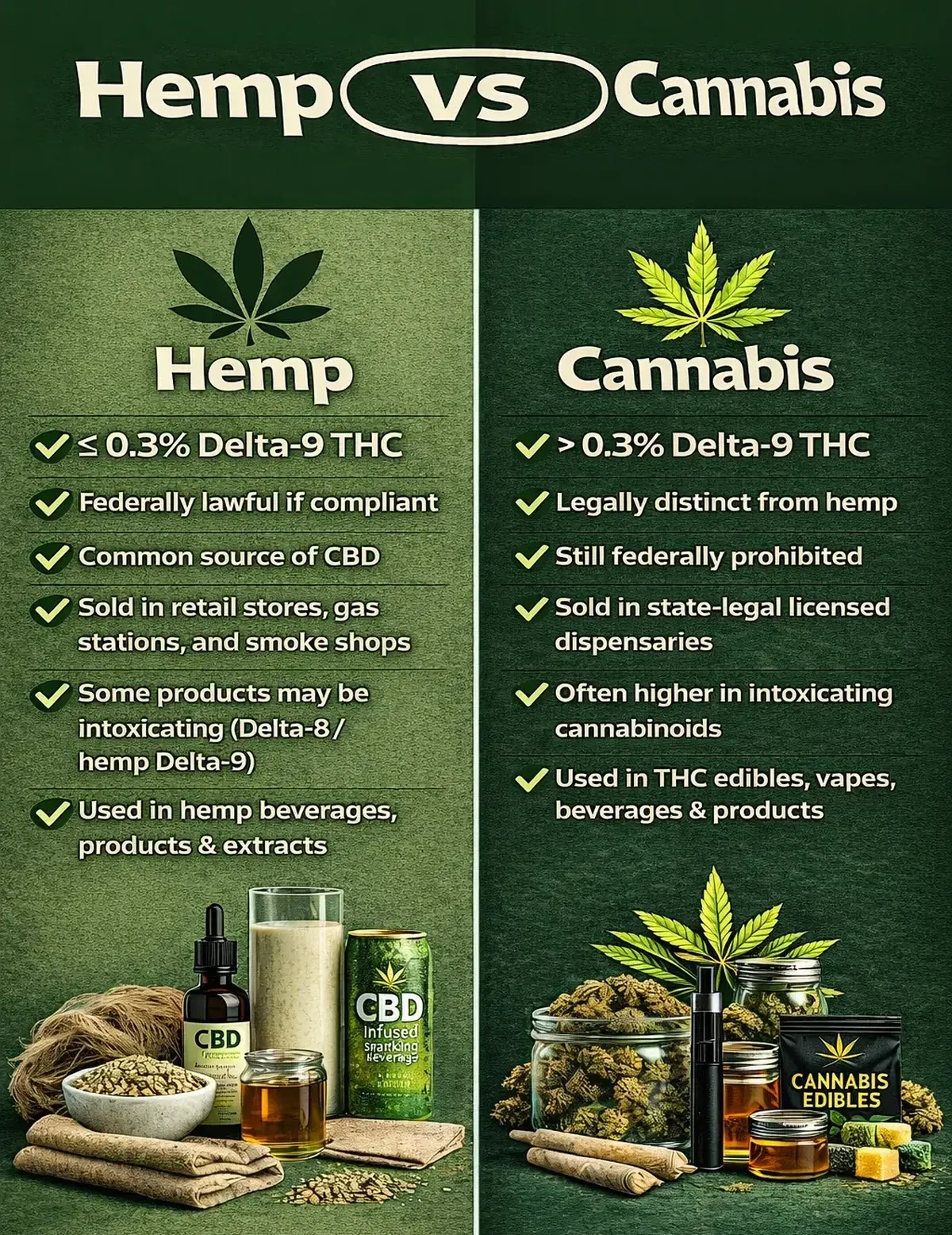
Short answer: Hemp and cannabis are both forms of Cannabis sativa, but the legal distinction is based mainly on THC concentration.
Under federal law, hemp is cannabis containing no more than 0.3% delta-9 THC by dry weight. Plants and products above that threshold fall outside the federal hemp definition and are generally treated as marijuana, even though many states regulate legal cannabis markets.
- Hemp: 0.3% delta-9 THC or less by dry weight
- Cannabis: more than 0.3% delta-9 THC by dry weight
What is a hemp beverage?
Short answer: A hemp beverage is a drink infused with cannabinoids derived from legally defined hemp plants.
These beverages often contain low doses of delta-9 THC or other cannabinoids and are formulated to fit within federal hemp rules.
Because they are derived from hemp rather than marijuana, some products are sold outside traditional dispensaries, including in liquor stores, restaurants, bars, or other retail channels, depending on state and local law.
How do hemp beverages differ from cannabis beverages?
Short answer: The main difference is legal and regulatory, not necessarily chemical.
Hemp beverages are made from cannabinoids derived from federally defined hemp. Cannabis beverages are made from cannabis products regulated through state medical or adult-use systems.
- Hemp beverages: may appear in conventional retail channels, depending on the jurisdiction
- Cannabis beverages: are typically limited to licensed dispensary systems
Are THC drinks legal in the United States?
Short answer: It depends on the source of the THC, the product formulation, and the laws of the state where the product is sold.
- Cannabis-derived THC drinks: usually sold only in regulated state cannabis markets
- Hemp-derived THC drinks: may be federally lawful if they comply with the 2018 Farm Bill, but state laws vary widely
In practice, legality often turns on how a state treats intoxicating hemp products and how the product is labeled, formulated, and distributed.
Can bars or restaurants sell THC drinks in Illinois?
Short answer: Cannabis-derived THC beverages are generally sold through licensed cannabis retailers, while hemp-derived THC drinks fall into a more uncertain and evolving regulatory category.
Illinois regulates adult-use cannabis through licensed channels administered by state agencies. Hemp-derived THC beverages may appear in traditional retail settings, but businesses should review current Illinois rules, local requirements, and product-specific compliance issues before selling them.
Because this area is evolving, operators should treat it as a compliance question, not just a product question.
What is the legal THC limit in hemp products?
Short answer: Under federal law, hemp is cannabis containing no more than 0.3% delta-9 THC by dry weight.
That threshold is central to the legal definition of hemp under the 2018 Farm Bill and is one of the main reasons hemp-derived beverages and similar products have become a distinct category in the market.
State rules can add additional restrictions beyond that federal definition.
What is the 2018 Farm Bill and why does it matter?
Short answer: The 2018 Farm Bill legalized hemp and created the legal framework that made today’s hemp product market possible.
The Agriculture Improvement Act of 2018 removed hemp from the federal list of controlled substances and defined hemp as cannabis containing no more than 0.3% delta-9 THC by dry weight.
- Legalized hemp cultivation and production
- Opened the door for CBD and hemp-derived THC products
- Created the legal foundation for hemp beverages and similar products
What is IRS Section 280E?
Short answer: Section 280E prevents cannabis businesses from deducting most ordinary business expenses on their federal taxes.
The rule applies because cannabis remains federally classified as a Schedule I controlled substance. As a result, licensed cannabis companies often face a much higher effective tax burden than businesses in most other industries.
This remains one of the most important financial constraints in the legal cannabis industry.
What does cannabis rescheduling mean?
Short answer: Rescheduling means moving cannabis to a different category under federal controlled substances law.
Cannabis is still listed by DEA as a Schedule I controlled substance. If federal regulators ultimately move it to another schedule, such as Schedule III, the change could affect taxation, research access, and federal oversight.
- Could reduce the impact of Section 280E
- Could make research easier
- Would not automatically create full federal legalization
Who regulates cannabis in Illinois?
Short answer: Cannabis regulation in Illinois is split across several agencies.
- Illinois Department of Financial and Professional Regulation: dispensaries and related oversight
- Illinois Department of Agriculture: cultivation, craft grow, infusion, transport, and related licensing
- Illinois Department of Public Health: public health and product-safety related functions
Illinois also coordinates cannabis oversight across agencies through the state’s Cannabis Regulation Oversight Office.
Why is the Midwest important to the cannabis industry?
Short answer: The Midwest has become one of the most important regions for cannabis market growth and policy development.
States including Illinois, Michigan, Missouri, and Minnesota have adopted different regulatory models, creating a varied regional landscape for operators, investors, and policymakers.
The region also matters because of its population centers, logistics networks, and growing role in shaping the next phase of cannabis regulation and market structure.
Why is cannabis research still limited in the United States?
Short answer: Research remains limited because federal law still creates significant barriers.
Although many states have legalized cannabis, the plant is still federally classified as a Schedule I substance. That creates extra approvals, compliance burdens, and sourcing challenges for researchers.
As a result, scientific understanding often lags behind market growth, product innovation, and consumer demand.
*This FAQ is designed as a practical reference page and will be updated as cannabis and hemp policy continue to evolve.