A Plant, a Panic, a Pivot: Cannabis Culture Between Prohibition and Normalization
Legalization changed markets, but not cultural memory. Cannabis today exists in a complicated space between prohibition-era fear and modern normalization.

Human beings have been consuming cannabis for roughly five thousand years.
Archaeological evidence points to ritual use in ancient Central Asia. Texts from China describe medicinal applications centuries before the Common Era. Across parts of Africa and the Middle East, the plant moved through trade routes as both intoxicant and medicine. In India, it became embedded in religious practice. In Europe and the Americas, hemp varieties supported textiles, rope, and agriculture long before psychoactive uses became widely discussed.
For most of history, cannabis was neither a moral crisis nor a commercial juggernaut. It was simply another plant humans learned to use — sometimes reverently, sometimes casually.
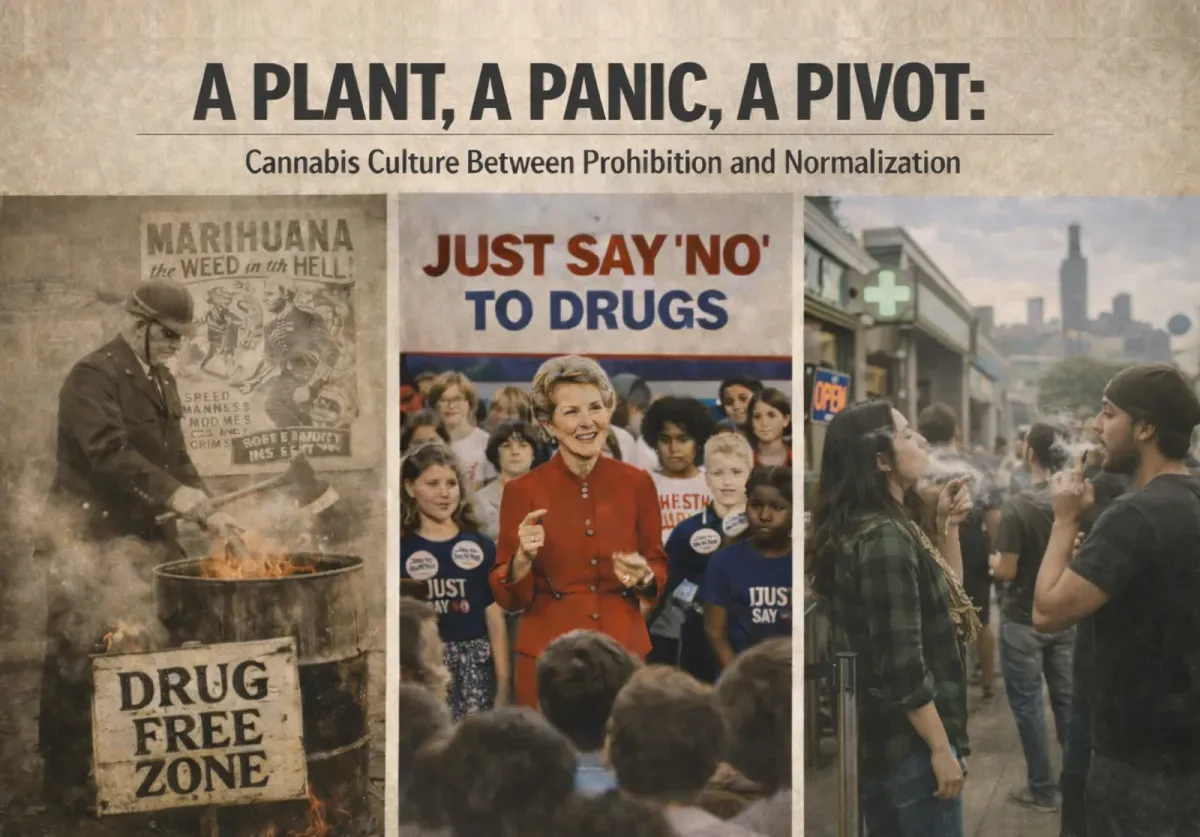
The modern perception of cannabis as uniquely dangerous is relatively recent, shaped less by pharmacology than by politics. In the United States, prohibition emerged alongside racially charged narratives that associated the plant with marginalized communities, immigrants, and social disorder. Media campaigns amplified fear, while laws imposed severe penalties disproportionate to the substance’s demonstrated harm relative to alcohol, tobacco, or many prescription drugs.
By the time most Americans came of age in the late twentieth century, the message was clear and unambiguous: cannabis was bad, illegal, and socially disqualifying.
For those growing up in the 1980s, this message was reinforced by the highly visible “Just Say No” campaign led by Nancy Reagan. The program treated cannabis as indistinguishable from cocaine, heroin, and other hard drugs, collapsing important distinctions into a single narrative of danger. Nuance was not part of the strategy. The goal was deterrence through fear, not education through evidence.
The human cost of that approach was unevenly distributed. In affluent communities, a cannabis arrest often meant embarrassment, parental discipline, or a minor legal consequence. In many poorer and predominantly Black neighborhoods, similar conduct could result in incarceration, criminal records, and cascading economic hardship. Families were disrupted, careers derailed, and entire communities destabilized.
Generations of Americans internalized these consequences long after the legal environment began to change.
Today, legalization in roughly forty states has transformed the commercial landscape but not entirely the cultural memory. Cannabis is simultaneously mainstream and stigmatized, celebrated and suspect. Venture-backed companies raise capital in ways that resemble technology startups. Hemp-derived beverages are sold in grocery stores and stadiums. Musicians, athletes, and public figures speak openly about use in ways that would have been career-ending decades ago.
Yet crossing a state line can still expose individuals to criminal penalties. The irony is particularly visible in the Midwest, where legal cannabis purchased in Michigan must be transported through Indiana, a state where possession laws remain strict. The plant’s legal status shifts not because of chemistry but because of jurisdiction.
As communities legalize and regulate, acceptance tends to follow. Residents observe that tax revenues materialize, crime does not spike dramatically, and the social fabric remains intact. Businesses begin to explore opportunities. Public officials grow more pragmatic. The sky, as it turns out, does not fall.
At the same time, new cultural tensions emerge.
Vaping devices — some containing cannabis, others nicotine — have become ubiquitous, particularly among younger users. Research suggests adolescent brains are especially sensitive to psychoactive substances, raising concerns about normalization before cognitive development is complete. Yet many young people now grow up in households where hemp beverages or other products are stored alongside alcohol, making exposure routine rather than transgressive.
This generation lacks the legacy biases of Baby Boomers, Gen X, and older Millennials, even as it faces its own set of uncertainties.
Public opinion has settled into a complex middle zone. Many individuals who personally dislike cannabis nevertheless accept that prohibition is neither practical nor desirable. Others view consumption as a personal liberty that should face minimal restriction. Between these positions lies a broad constituency seeking sensible guardrails: safety standards, age limits, clear labeling, responsible marketing, and public spaces where use does not impose on non-users.
Cannabis increasingly occupies the same conceptual category as other “sin” consumer goods — alcohol, tobacco, gambling — while also retaining a foothold in medicine and wellness. For some users, it functions as a social lubricant; for others, a therapeutic tool; for still others, a performance enhancer that they believe improves creativity or focus without impairing daily responsibilities. Many consumers incorporate it discreetly into routines that remain outwardly conventional.
Beverages may prove to be the gateway to broader cultural integration. Drinking is inherently social, and low-dose formulations offer a controlled experience that resembles alcohol consumption without some of alcohol’s well-documented harms. Major consumer brands are monitoring this trend closely as traditional drinking declines among younger cohorts.
Cities like Chicago occupy a particularly interesting position. The region hosts a large professional workforce within the cannabis industry, extensive infrastructure investments, and a musical and artistic heritage that has long intersected with cannabis culture — from blues clubs to contemporary festivals. Enforcement practices at concerts and events have softened dramatically compared to a generation ago, reflecting shifting norms even in the absence of fully developed policies.
What remains underdeveloped are regulated public consumption spaces where use can occur safely, transparently, and without ambiguity for businesses or patrons. Hotels, restaurants, clubs, and event organizers often operate in gray areas, accommodating behavior they cannot formally endorse. Clear frameworks could reduce risk while acknowledging reality.
Cultural integration does not mean universal approval. Some communities will continue to oppose cannabis use on moral, religious, or public health grounds. Others will embrace it enthusiastically. Most will land somewhere in between.
The challenge is not to eliminate disagreement but to manage coexistence.
After decades of prohibition followed by rapid commercialization, uncertainty is inevitable. Long-term health impacts, optimal regulatory models, and social consequences are still being studied. Markets are evolving faster than institutions can adapt. Messaging remains inconsistent. Consumers face a confusing array of products and claims.
Finding a stable equilibrium will require patience, humility, and a willingness to learn from both successes and mistakes.
In the end, cannabis is neither the cultural apocalypse envisioned by past campaigns nor a universal remedy for modern anxieties. It is a plant with a long human history, now navigating a modern landscape of law, commerce, and social norms.
Somewhere between prohibition and celebration lies a workable consensus — a middle ground where individual choice, public health, economic opportunity, and cultural diversity can coexist.
The work of building that consensus is only beginning.